

The phone rings at 3:47 PM on a Tuesday. Your subcontractor's employee just fell from scaffolding on your job site. Serious injuries. OSHA's already been notified. As you scramble to respond, another question hits: “Can you send us the subcontractor’s current certificate of insurance?”
You pull up the spreadsheet. The ACORD 25 reveals the policy expired 63 days ago. And nobody caught it.
That oversight has now become a six-figure problem—recent industry analysis estimates that the average worker-to-worker claim is in the vicinity of $400,000, up from approximately $250,000 in 2017.
For commercial property owners, customer slip‑and‑fall claims average around $20,000 per incident at small businesses, enough to squeeze margins—especially when more than one claim lands in the same policy period. Either way, you're staring at financial devastation because someone didn't check a date in a spreadsheet.
Manual certificate of insurance (COI) tracking is a hidden bankruptcy risk because spreadsheets cannot keep up with expiring policies, mid‑term changes, and growing vendor lists. Automated certificate of insurance tracking software gives you real‑time visibility into coverage, proactive alerts, and compliant vendors without the manual labor.
These seven often‑ignored costs show why staying manual is far more expensive than switching to automation.
Key Takeaways
- Manual certificate of insurance tracking costs construction and property management companies an average of $36,400 annually in labor alone—before accounting for missed expirations and liability exposure.
- The biggest financial risk isn’t labor cost—it’s false confidence in outdated certificates that no longer reflect actual coverage.
- Processing delays, compliance gaps, and poor documentation quietly increase dispute severity, OSHA exposure, and insurance premiums over time.
- Automated COI tracking shifts insurance compliance from a reactive admin task into a continuous risk control insurers and regulators expect.
- Businesses that automate COI tracking earlier gain a structural advantage: faster vendor onboarding, cleaner audits, and lower long-term risk costs.
1. Manual COI Tracking Costs $36,400 Per Year in Labor
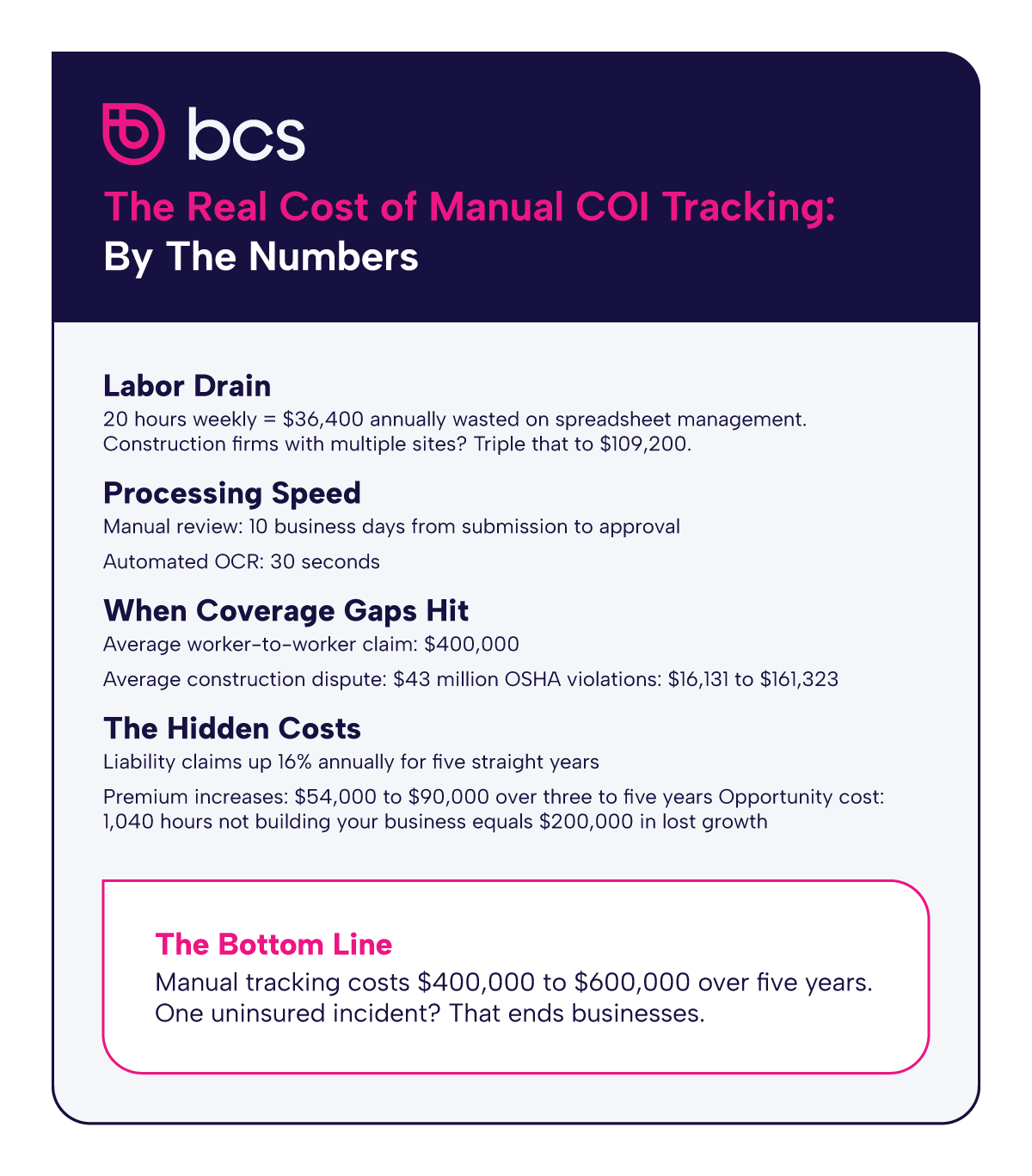
Your team spends 20 hours weekly tracking certificates. That's not an exaggeration, but the industry average for manual COI management. At $35 per hour, you're burning $36,400 annually on administrative tasks that generate zero revenue.
Break down those 20 hours: four hours chasing vendors for renewals, six hours manually entering data from PDF certificates, three hours cross-referencing coverage requirements, two hours following up with insurance agents, and five hours generating compliance reports nobody reads until there's an incident.
Property management companies with 200+ vendors often double that workload, burning roughly $72,800 a year in manual COI labor, while construction firms running multiple job sites can triple it—spending about $109,200 annually before you’ve built anything or collected a single rent check.
2. Processing Delays That Cost You Real Money
Manual certificate tracking moves at human speed. A vendor submits insurance documentation on Monday. Your team reviews it on Wednesday. They spot a deficiency on Thursday. And the vendor corrects it the following Tuesday. Project approval? Next Friday. Meanwhile, 10 business days have passed.
During that delay, your project sits idle, or your vendor can't access the property. Even on a mid‑sized project, it’s common for a single day of delay to burn thousands of dollars in extended equipment rentals, idle labor, and liquidated damages—costs that stack up fast when a paperwork issue pushes approvals out by a week or more.
Property management delays mean lost vendor services, deferred maintenance, and tenant complaints that tank your reviews and renewability rates.
A 2024 Arcadis construction dispute report estimates that the average value of a construction dispute now averages roughly $43 million in North America. While not all disputes stem from insurance delays, poor documentation and gaps in project records are repeatedly cited as key factors that turn routine disagreements into protracted, high‑stakes litigation.
3. Coverage Gaps Manual COI Tracking Software Fails to Detect
Here’s where manual tracking becomes catastrophic.
Your spreadsheet still shows your subcontractor’s general liability limit at $2 million per occurrence, matching the ACORD 25 you filed six months ago. But ACORD certificates are issued “for information only” and do not automatically update to reflect mid‑term endorsements or limit changes, so when the subcontractor quietly cuts their GL limit, your manual process never catches it.
The subcontractor reduced GL coverage to $500,000 to save on premiums. You discover this after the incident—when their carrier pays their limit and leaves you holding $1.5 million in liability exposure.
Liability claims costs in the United States have increased 16% annually over the past five years. Social inflation. Aggressive litigation. Nuclear verdicts. That gap between what you thought you had and what actually exists? It bankrupts businesses quarterly.
4. OSHA Violations Caused by Poor COI Tracking and Vendor Compliance
OSHA conducted 34,625 inspections in 2024, half of which were unannounced. When inspectors arrive and discover you've allowed uninsured or underinsured contractors on site, violations start at $16,131 per incident and can reach $161,323 for willful or repeated violations.
But the fines are just the visible cost.
OSHA violations don’t just generate fines; they also show up in the data your insurance carriers use to price risk. Citations often trigger deeper underwriting reviews that look for patterns in your safety record, and repeated or serious violations can lead to coverage restrictions, double‑digit premium increases, and, in some cases, non‑renewal at renewal time.
Try securing contractor GL, workers’ comp, and auto coverage after a major carrier non‑renews you for losses or compliance issues. Your market options shrink, replacement coverage often comes from higher‑priced surplus lines carriers, and premiums can jump dramatically—sometimes nearly doubling.
On top of that, many public and private project owners won’t let you bid or start work unless your insurance program meets strict limits and endorsement requirements, so lacking the right coverage can make some projects effectively unbiddable for your firm.
5. Premium Increases You Didn't Budget For
Insurance carriers raised construction premiums 4.6% in Q1 2024. Auto liability? Up 8-18%. Excess liability? Up 5-12%. General contractors and property owners with poor certificate management practices face increases at the high end of those ranges—or higher.
Why? Your insurance carrier views certificate tracking as risk management. Weak tracking signals weak risk controls across your operation. They price that risk directly into your premium. A $100,000 annual insurance bill becomes $118,000 because your certificate spreadsheet demonstrates you can't manage basic compliance.
Multiply that $18,000 increase across three to five years. You've paid an extra $54,000 to $90,000 in premiums because manual tracking sent the wrong signal about your risk profile.
6. The Opportunity Cost of Managing COIs Without Automation
20 hours weekly on certificate tracking means 1,040 hours annually that your team isn't spending on revenue-generating activities. For construction companies, that's time not spent estimating new projects, developing client relationships, or improving operational efficiency. For property management firms, it's time not spent on tenant retention, property improvements, or portfolio expansion.
Calculate the opportunity cost: if those 1,040 hours redirected toward business development generate just one additional $500,000 project or property acquisition at 8% margin, you've gained $40,000 in profit. Over five years, that's $200,000 in growth you sacrificed to manually track PDFs.
Companies crushing it right now? They're not working harder at certificate management. They automated it six years ago and redirected that capacity to actual business building.
7. The Uninsured Incident That Ends Everything
Severe construction injuries—such as spinal damage, amputations, or fatalities—often result in settlements or verdicts in the high six‑figures to low millions of dollars, especially when long‑term disability is involved.
Again, the average construction dispute costs $43 million when legal fees, project delays, and settlements compound. A violent crime on your property with an underinsured security vendor? Claims escalate into seven figures when victims pursue landlord liability.
That single uninsured incident doesn't just cost money. It costs your business. Many SME businesses can't absorb million-dollar liabilities on a $3-5 million annual revenue operation. The math doesn't work. So, bankruptcy becomes the only option because a spreadsheet missed an expiration date.
How Automated Certificate of Insurance Tracking Software Eliminates These Costs
Manual tracking fails at scale. Humans can't simultaneously monitor hundreds of vendors, thousands of data points, and constantly changing requirements. Certificate of insurance tracking software doesn't replace people—it removes the manual tasks that drain their time and create liability exposure.
The workflow transforms completely:
Upload a certificate. Automated OCR technology reads it in 30 seconds. Policy numbers extracted. Coverage limits verified. Effective dates cross-referenced. Additional insured requirements confirmed. The system compares everything against your specific requirements.
Deficiency detected? Immediate alerts with exact gaps: "General liability shows $500K—your project requires $2M." No guessing. No manual review. No three-day delay while someone gets to it.
Renewal tracking runs continuously without human intervention. Sixty days before expiration, automated notifications reach vendors and your team. Thirty days out, second reminders. Fifteen days, escalation alerts. That certificate expiring unnoticed in your spreadsheet? Nearly impossible now.
Integration creates unified visibility. Your project management software shows compliance status alongside construction schedules. Property management platform displays vendor insurance right next to work orders. No platform switching. No manual data synchronization. Compliance becomes visible, verifiable, and enforceable across your entire operation.
Why bcs Delivers Results Manual Processes Can't Match
bcs combines AI-powered automation with a comprehensive vendor network reach that manual tracking can't replicate.
- RiskBot analyzes certificates instantly using proprietary OCR technology trained on millions of insurance documents.
- Color-coded compliance indicators show exactly what's compliant and what needs attention—no insurance expertise required.
The vendor experience matters. No logins required. No complicated portals. No friction. Vendors upload certificates directly, receive immediate feedback on deficiencies, and know exactly what's needed for approval. This streamlined process means faster corrections and compliance rates that actually move.
98,000+ active vendors already in the network. Your new subcontractor likely already uses bcs. Your HVAC contractor? Probably there. That electrical sub you just hired? Already onboarded. This eliminates duplicate data entry and accelerates project starts across your entire operation.
Support from US-based licensed insurance professionals in multiple languages ensures you're never stuck decoding whether a contractor's Workers' Comp policy meets your state requirements or if their Auto Liability limits are adequate. Questions about ACORD certificate language? Answered immediately by experts who understand construction, commercial real estate, healthcare, HOAs, school districts, universities, and municipal operations—any sector facing certificate tracking challenges.
Try bcs premium free and see exactly how much manual COI tracking is costing your business right now. No credit card required. No complicated implementation. Just upload your current vendor certificates and watch automated tracking start protecting your bottom line immediately.