Certificate of Insurance (COI) Tracking for Schools and School Districts
COI and vendor compliance tracking for K-12 districts, private and charter schools, and colleges and universities: every contractor, campus vendor, and facility-use renter, verified and current.
bcs tracks certificates of insurance for schools, districts, and universities, verifying that every contractor, vendor, and facility-use renter on campus carries the coverage and additional insured status your agreements require. Vendors submit COIs through a no-login link, bcs reads each certificate with two independent methods, and a dedicated team can pursue every vendor to full compliance.
18 years
of vendor compliance
9,000,000+
certificates and policies reviewed
200,000+
vendors and tenants tracked annually
Start Protecting Your Institution
Keep your campus safe with smarter vendor screening and COI management.
Built for Institutions Like Yours
School DistrictsPrivate SchoolsUniversities and CollegesTechnical and Trade SchoolsEducational Service CentersCharter School Networks
two-factor COI review
bcs reads every certificate with two independent methods, a deterministic engine (OCR plus computer-vision box detection, with insurance logic built in) and a separate AI vision model, that must arrive at the same reading before a finding is trusted. This independent cross-check, the “two-factor authentication” of COI review, catches the confident misread that single-engine tools ship as “compliant.”
Method one
Deterministic engine
OCR plus computer-vision box detection, with insurance logic built in.
GL limit read: $1,000,000
Method two
AI vision model
A separate model reads the same certificate independently.
GL limit read: $1,000,000
=
Both readings agree, the finding is trusted
When they disagree, the certificate routes to a human reviewer.
Built for Education
COI tracking built for education
From automated review to deficiency notices, renewals, and custom rules, bcs handles every step of certificate of insurance tracking for your district or campus.
client.getbcs.com
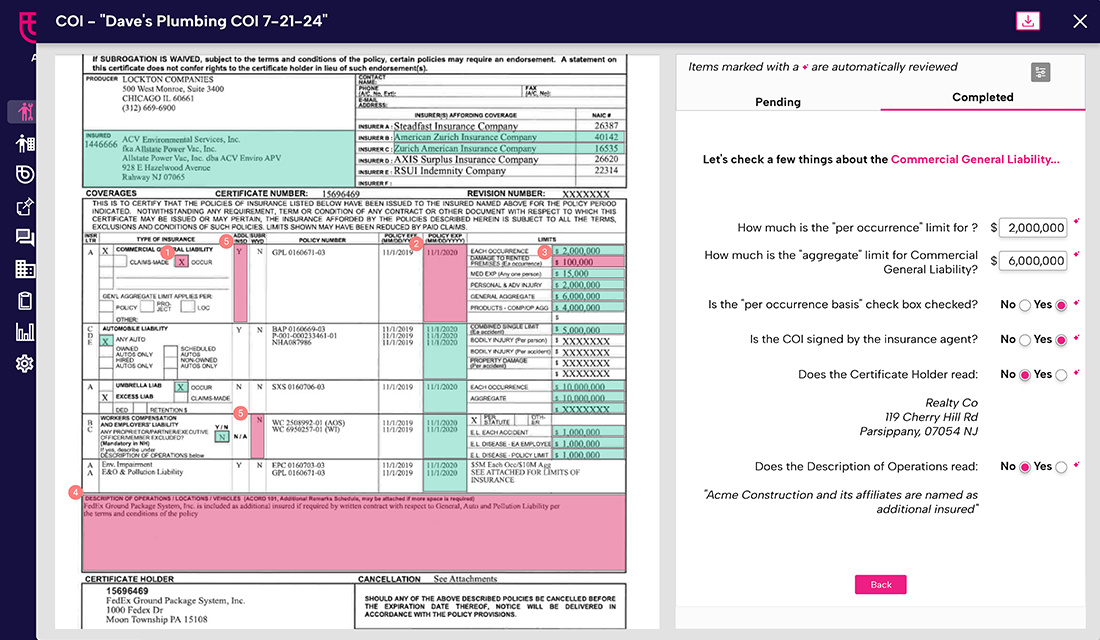
Color-coded instant feedback makes reviewing COIs much simpler. The COI data is automatically extracted and checked against your requirements.
Two-factor review
Automated COI Review
Every certificate of insurance is read twice. A deterministic engine (OCR plus computer-vision box detection with insurance logic built in) and a separate AI vision model must agree before a finding is trusted. Coverage types, limits, dates, and additional insured status are checked against your district's requirements automatically.
client.getbcs.com
Vendors and their agents get the exact deficiency and what to fix, with follow-ups until it is resolved.
No phone tag
Automated Deficiency Notices
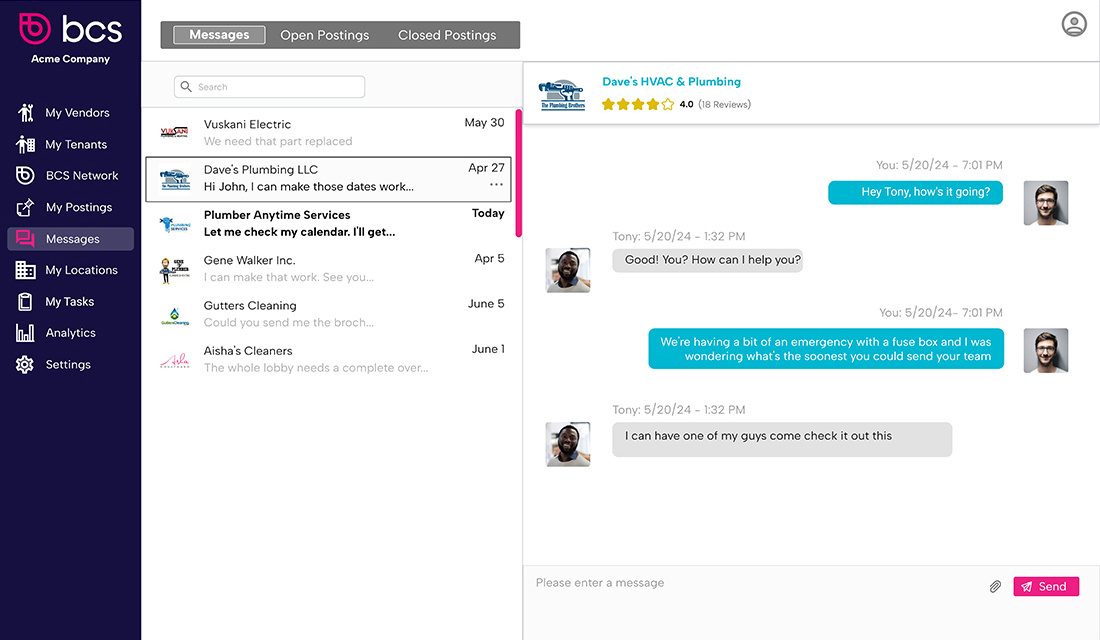
When a certificate falls short, bcs notifies the vendor and their insurance agent with the exact deficiency and what is needed to correct it, then keeps following up. No phone tag, no manual email threads, and a full record of every request on the vendor's file.
client.getbcs.com
Renewal requests go out ahead of every expiration date, so no vendor works uninsured.
Before coverage lapses
Automated Renewals
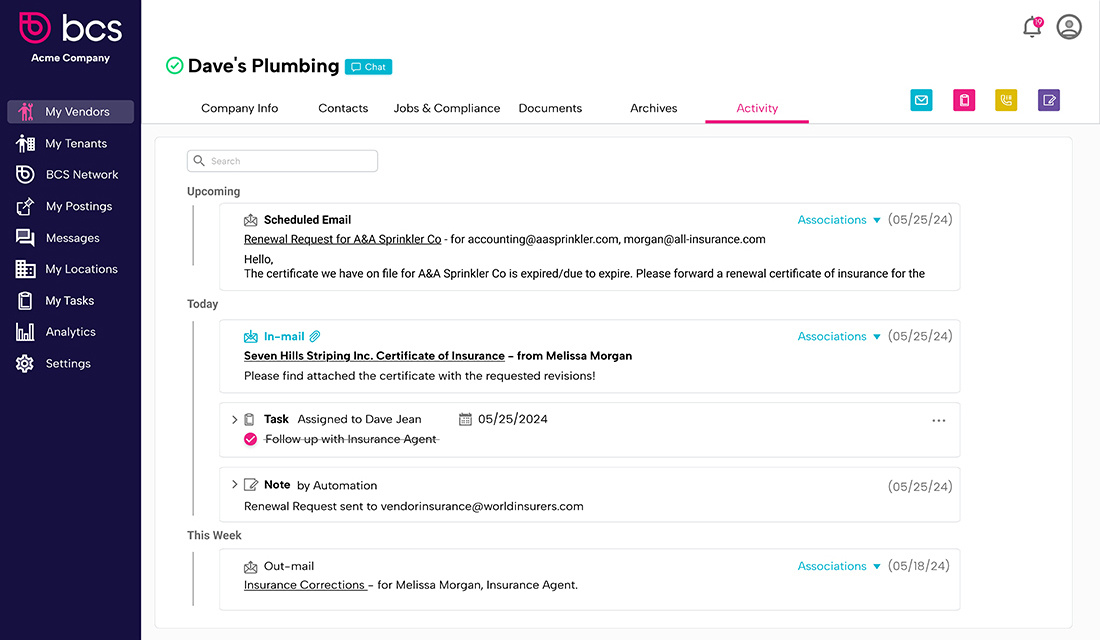
bcs tracks every policy expiration date and sends renewal requests to vendors and their agents ahead of the lapse, so no contractor, campus vendor, or facility-use renter works uninsured, including through the summer construction spike and the back-to-school re-credentialing wave.
client.getbcs.com
Set coverage requirements once by vendor type, then apply them across every campus.
Your requirements
Custom Compliance Rules
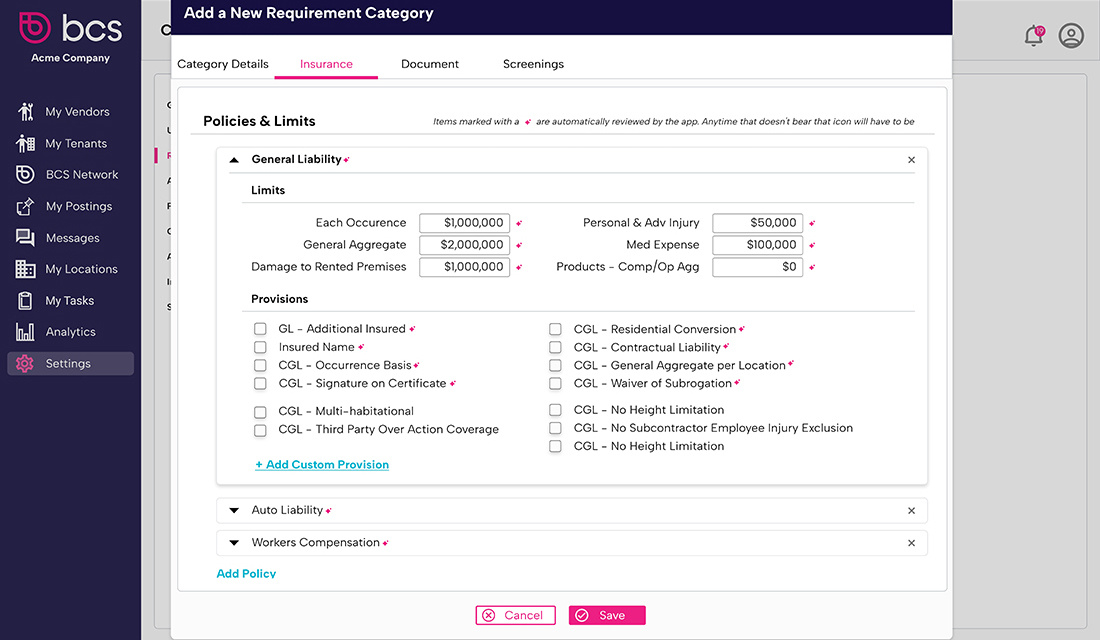
Define coverage limits, endorsements, and additional insured language once as a Requirement Category, then apply it by vendor type: food service, transportation, construction, athletics, facility-use renters. Every certificate is measured against the right standard for that relationship.
Six places a district's third-party risk actually lives
All six tracked in one system
01Vendors and contractors
Risk surface 01 / 06
District wide
District and campus vendor and contractor COIs.
Schools and districts contract with more third parties than almost any other buyer their size: food service and cafeteria vendors, student transportation and bus contractors, construction and renovation crews (heaviest over summer break), IT and edtech installers, landscaping and grounds, custodial, and security. bcs tracks a certificate of insurance for each one, checks coverage types, limits, and dates against the district's requirements, and flags any vendor whose coverage lapses or falls short before they set foot on campus.
02Facility-use agreements
Risk surface 02 / 06
Additional insured
Additional insured for facility-use agreements.
When a district lets an outside group use its gyms, fields, auditoriums, or classrooms (youth sports leagues, community education, camps, private events), the facility-use agreement almost always requires the district to be named as an additional insured on the renter's policy. bcs tracks additional insured status on every certificate, monitors coverage and expiration dates so a renter's policy cannot lapse mid-season, and flags any certificate that is missing or non-compliant so it can be corrected before the event. Special event coverage is tracked the same way.
03Athletics and field trips
Risk surface 03 / 06
Building level
Coaches, activity vendors, athletics, and field trips.
Booster clubs, camps, officials and referees, private coaches, club sports, and field-trip providers (venues, charter buses, chaperoned activities) all introduce third-party risk that rarely runs through central procurement. bcs gives athletic directors, activity coordinators, and building administrators one place to collect and verify these certificates, so activity-level and trip-level vendors are held to the same standard as district-wide contractors.
04No-login submission
Risk surface 04 / 06
Vendor experience
No-login vendor submission.
School vendors are often small, non-technical, and one-time (a single field-trip venue, a summer camp operator, one booster-club contractor). Forcing them to create an account is where compliance stalls. With bcs, a vendor submits a certificate through a single no-login link, and the document files itself to the right record automatically. Less friction for the vendor means faster, higher compliance for the district.
05Multi-campus access
Risk surface 05 / 06
Permissions
Multi-campus oversight and site-level access.
A district is many buildings under one compliance standard. bcs rolls compliance up across every campus while letting each principal, site manager, or athletic director see only their own building's vendors through location-based user access, with the central risk or business office keeping the full-district view.
06The seasonal surge
Risk surface 06 / 06
Seasonality
The seasonal surge.
Vendor risk in education is seasonal: a construction and renovation spike over summer break, a re-credentialing wave at back-to-school, activity and athletics vendors across the year. bcs's automated collection, review, and renewal tracking absorbs the surge without adding staff, so the business office is not manually chasing certificates every August.
The short version
What a district should know about COI tracking
What it is
COI tracking for schools is the process of collecting and verifying certificates of insurance from every contractor, campus vendor, and facility-use renter, so a district can prove each third party carries the coverage and additional insured status its agreements require.
The highest-risk certificate
For a school district, the highest-risk certificate is usually the facility-use agreement: when an outside group rents a gym or field, the district must be named as an additional insured, and bcs tracks additional insured status on the certificate, not just whether a certificate was submitted.
Why compliance sticks
School vendors are often small and one-time, so bcs lets them submit a certificate of insurance through a single no-login link that files the document to the right record automatically, which is how districts reach high compliance without chasing every booster club and field-trip provider.
bcs reads every certificate with two independent methods, a deterministic engine (OCR plus computer-vision box detection, with insurance logic built in) and a separate AI vision model, that must arrive at the same reading before a finding is trusted, so a district is not relying on a single tool's confident misread.
Keep your campus protected with automated COI tracking
Get a personalized tour of how bcs can transform your COI tracking. Join the growing number of educational institutions using bcs to protect their communities and streamline operations.
COI tracking for schools is the process of collecting, verifying, and monitoring certificates of insurance from every contractor, campus vendor, and facility-use renter a district works with, so the district can prove each third party carries the coverage and additional insured status its agreements require. It covers district-wide contractors (food service, transportation, construction, IT), building-level and activity vendors, and outside groups that use school facilities. For how COI tracking works in general, see what COI tracking is.
Schools contract with a large and shifting set of third parties, and any one of them with lapsed or inadequate coverage can leave the district paying for a loss it assumed was insured. Tracking certificates of insurance confirms that contractors, campus vendors, and facility-use renters carry current, adequate coverage and name the district as an additional insured where required, which protects the district's budget and its people from third-party claims.
Districts typically require certificates of insurance from food service and cafeteria vendors, student transportation and bus contractors, construction and renovation crews, IT and edtech installers, landscaping, custodial and security providers, and any outside group that uses school facilities. Building-level and activity vendors (camps, clubs, officials, field-trip providers) should meet the same standard as district-wide contractors.
When an outside group uses a school gym, field, auditorium, or classroom, the facility-use agreement usually requires the district to be named as an additional insured on the renter's policy. bcs tracks additional insured status on the certificate, monitors coverage and expiration dates so the coverage stays active for the event, and flags any certificate that is missing or non-compliant so the district can get it corrected. The same tracking covers special event coverage.
Yes. Booster clubs, private coaches, camps, officials, club sports, and field-trip providers all introduce third-party risk that rarely runs through central procurement. bcs gives athletic directors and activity coordinators one place to collect and verify these certificates, so activity-level vendors are held to the same coverage standard as district-wide contractors.
With bcs, a vendor submits a certificate of insurance through a single no-login link, and the document files itself to the correct record automatically. Because most school vendors are small or one-time, removing the account requirement is what lets a district reach high compliance without manually chasing every booster club, camp, or field-trip provider.
Yes. bcs rolls compliance up across every campus in a district while letting each principal, site manager, or athletic director see only their own building's vendors through location-based user access, with the central risk or business office keeping the full-district view. Districts can run tracking in-house on the software or hand the entire process to a dedicated bcs team.

 two-factor COI review