

Summary: Certificate of insurance tracking is the systematic process of verifying that vendors and contractors maintain required insurance coverage to protect your organization from liability exposure. Modern AI-powered platforms analyze policy language in real time, flag coverage gaps automatically, and provide continuous monitoring—preventing situations where uninsured vendors expose you to catastrophic claims.
Every risk manager knows the uncomfortable truth: third-party relationships are both essential and inherently dangerous. Your organization depends on vendors, contractors, and service providers to operate. At the same time, each relationship introduces potential liability that could devastate your business if something goes wrong.
Certificate of insurance (COI) tracking exists to manage this paradox.
COI tracking is the systematic process of collecting, verifying, and monitoring insurance certificates from third parties who work with or on behalf of your organization.
The practice ensures that every vendor maintains required coverage limits and policy types before they begin work—and continuously throughout your business relationship.
For risk managers specifically, certificate of insurance tracking represents your first line of defense against catastrophic liability exposure. When a contractor's insurance lapses or proves insufficient during an incident, your organization becomes the target.
The financial and reputational damage from a single uninsured claim often reaches seven figures.
Key Takeaways
- Certificate of insurance tracking verifies that vendors and contractors maintain required insurance coverage to protect organizations from liability exposure
- Manual tracking methods create dangerous compliance gaps that expose businesses to million-dollar claims when uninsured incidents occur
- Basic automated systems improved efficiency but still require substantial human oversight to catch coverage gaps and interpret policy details
- Modern AI-powered platforms analyze policy language, flag coverage deficiencies, and automate follow-ups in near real time
- Risk managers can now pilot comprehensive AI tracking systems at no cost before committing to enterprise-wide implementation
Why Risk Managers Need Specialized Tracking Systems
Unlike project managers or procurement teams who focus on vendor performance and deliverables, risk managers carry responsibility for the entire organization's exposure. You report to boards and executives. You manage insurance programs across multiple business units. And you need comprehensive visibility into third-party risk that extends beyond individual projects or departments.
This broader scope creates unique challenges. You're tracking certificates across construction projects with complex insurance requirements, facility management contracts, professional services agreements, and supplier relationships.
Each comes with different insurance requirements. Each presents distinct risk profiles. And each requires ongoing monitoring throughout multi-year engagements.
Manual tracking methods—spreadsheets, email folders, physical files—can't scale to meet these demands.
The administrative burden alone consumes 15-20 hours weekly for teams managing significant vendor networks. More critically, manual processes inevitably produce compliance gaps that become apparent only after an incident occurs.
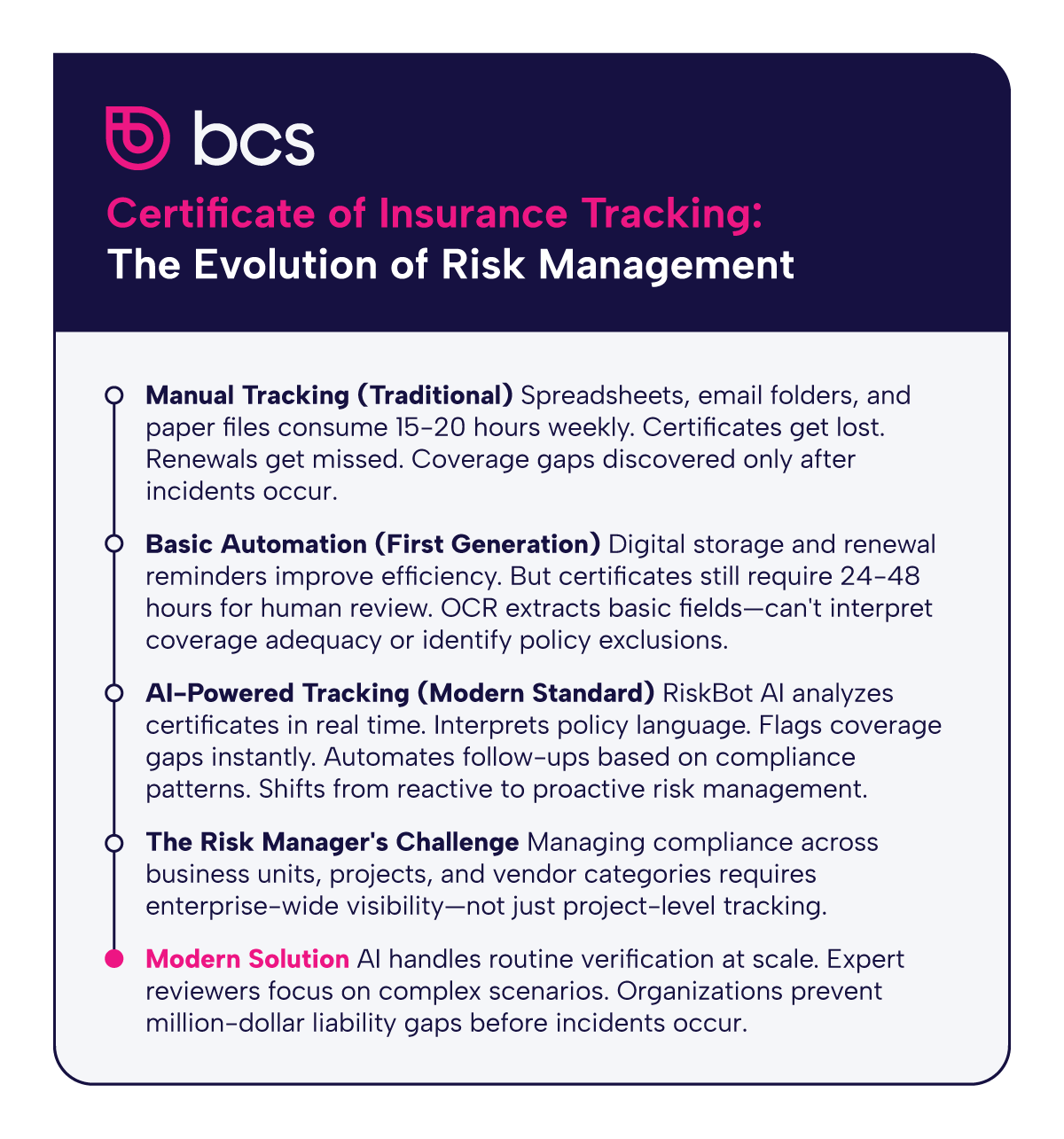
The Evolution: From Manual to Automated to AI-Powered
Understanding how COI tracking has evolved helps risk managers evaluate current options and make informed platform decisions.
Manual tracking represented the industry standard for decades. Risk management teams collected paper certificates, filed them alphabetically, and set calendar reminders for renewal dates. This approach required significant staff time and produced predictable failure patterns.
However, certificates got lost. Renewal dates got missed. Policy details went unverified. And organizations discovered coverage gaps only when filing claims after incidents.
The fundamental limitation wasn't staff competence or effort, though. Manual methods simply couldn't maintain accuracy at scale. A risk manager overseeing 200 vendor relationships would need to review dozens of certificates monthly just to stay current—before accounting for new vendor onboarding, requirement changes, or policy modifications.
Seasoned risk managers know the pains.
Basic automation emerged as the industry's first technology solution more than 20 years ago. These platforms digitized certificate storage and created automated renewal reminders. Vendors could upload certificates to portals rather than sending PDFs via email. The system would alert staff when expiration dates approached.
This represented real progress. Digital storage eliminated lost certificates. Automated alerts caught more renewals before they lapsed. But fundamental limitations remained.
Someone still needed to manually review each certificate against requirements. OCR-based certificate of insurance tracking systems could extract basic fields like dates and policy numbers, but couldn’t interpret coverage adequacy or identify subtle policy exclusions that created exposure.
Most platforms still required 24-48 hours for human review of each submission. Complex certificates needed manual data entry when OCR failed to read non-standard formats. Risk managers gained efficiency but still operated largely reactive systems that caught problems only after submission. That’s too late.
AI-powered tracking represents the current generation of COI tracking technology. These platforms go beyond field extraction to interpret policy language, assess coverage adequacy against specific requirements, and identify gaps that create organizational exposure.
Advanced systems like bcs’ RiskBot AI can analyze uploaded certificates in real time, providing instant color-coded feedback on compliance status.
Unlike earlier automation, these platforms can:
- Identify coverage gaps, endorsement issues, and requirement mismatches without human review
- Flag vendors approaching non-compliance before policies expire
- Automate follow-up communications based on vendor behavior and compliance patterns
The shift from reactive to proactive risk management is substantial.
Rather than discovering coverage gaps during claim investigations, risk managers receive alerts when vendors submit deficient certificates. All before work begins. The system continuously monitors the entire vendor portfolio and surfaces emerging risks across the organization.
What Should Risk Managers Evaluate in Modern Tracking Platforms?
Technology capabilities matter, but risk managers need to assess platforms through a different lens than operational teams. Consider these factors when comparing subcontractor insurance tracking solutions:
- Portfolio visibility across business units. You need consolidated views of compliance status regardless of how your organization structures vendor relationships. The platform should enable you to assess risk enterprise-wide, not just within individual projects or departments.
- Policy-level analysis capabilities that go beyond rudimentary compliance. Basic platforms verify that certificates exist and haven't expired. Risk-focused platforms analyze whether coverage types and limits adequately protect your organization from realistic claim scenarios. This distinction becomes critical when underinsured vendors cause incidents.
- Integration with existing risk systems. Your COI tracking platform should connect with risk management information systems, insurance carrier portals, and claims management platforms. Isolated data creates blind spots that undermine comprehensive risk assessment.
- Audit trail and documentation standards. When incidents occur, you'll need detailed records demonstrating due diligence. The platform should maintain comprehensive documentation of verification activities, vendor communications, and compliance decisions throughout each business relationship.
- Expert support for complex requirements. AI handles routine verification, but edge cases still emerge—particularly with specialized contractors, international vendors, or unique coverage scenarios. Access to licensed insurance professionals who can interpret complex policy language remains invaluable.
Read our COI tracking software buyer’s guide to compare the top platforms in 2026.
The Role of Human Expertise in AI-Powered Systems
The most sophisticated AI systems don't eliminate human expertise, but optimize when and how that expertise gets applied.
Modern platforms use AI to handle routine verifications and standard compliance scenarios, freeing expert reviewers to focus on genuinely complex situations.
This approach delivers better outcomes than either purely automated or purely manual systems by combining:
- Consistent, instant analysis across thousands of certificates through AI
- Human review for edge cases where policy interpretation requires professional judgment
- The speed and reliability of automation with the quality assurance of expert oversight risk managers need
For organizations managing compliance across property management portfolios that require integrated COI tracking, construction projects, or multi-location operations, this combination proves particularly valuable.
The AI scales to handle volume while experts ensure complex requirements are properly verified.
Simplify Your Organization's Third-Party Risk Management with bcs
The gap between manual tracking and modern AI-powered platforms is measured in both hours saved and incidents prevented.
Risk managers continuing with outdated methods operate at a fundamental disadvantage—slower response to compliance issues, reduced visibility into organizational exposure, and reactive rather than proactive risk management; you’re much more likely to experience coverage gaps.
And those liabilities are simply not worth the risk.
Leading COI tracking company bcs eliminates these limitations through RiskBot AI, the industry's first autonomous compliance agent.
Unlike basic platforms that simply extract certificate data, RiskBot interprets policy details, identifies coverage gaps, and automates follow-up communications in near real time. The system goes beyond basic OCR to understand what certificates actually mean for your risk profile.
Organizations working with bcs gain immediate advantages through:
- A network of 98,000+ pre-verified vendors that accelerates onboarding
- A no-login submission process that eliminates common vendor adoption barriers
- Direct certificate uploads without accounts or complex portals
- Instant, color-coded compliance feedback during upload powered by proprietary OCR
- Licensed insurance professionals who provide expert review at no additional cost for complex scenarios
Risk managers choose bcs because the platform delivers comprehensive visibility across their entire third-party portfolio.
You can assess compliance status by business unit, project, vendor category, or policy type. Integration with leading platforms, including Procore, Yardi, and MRI, ensures your COI data flows into broader risk management workflows.
Most importantly, you can validate these capabilities with your actual vendor relationships before making any financial commitment. bcs offers the industry's only true freemium platform—full access to all features, including RiskBot AI for up to 25 vendors at no cost, with no time limits or feature restrictions.
Stop gambling with manual COI tracking. This exposes your business to million-dollar liability gaps and wastes 15-20 hours weekly on administrative chaos. bcs’ proprietary AI delivers instant insurance verification, 98,000+ pre-verified vendors that accelerate onboarding, free-tier access with flexible upgrades that scale with your business, and 24/7 U.S.-based human expert support—ensuring you never face uninsured incidents. Try bcs premium for free today.
Frequently Asked Questions