

Summary: Most COI tracking software makes you pick a delivery model and commit to it. That's the problem bcs was built to solve—it's the only platform offering self-service, full-service, and a true freemium tier for up to 25 vendors within a single account, no migration required. The right model depends on four things: your vendor volume, your team's true capacity, your requirement complexity, and how much your program is likely to change.
Your compliance manager gave you two weeks' notice on a Monday. By Wednesday, you have 280 active vendors, 34 certificates expiring in the next 60 days, and a project director asking whether you can onboard three new subcontractors before the weekend. You start shopping for COI tracking software. Every platform you demo makes you choose: run it yourself, or let them run it for you. Neither option fits what you need right now.
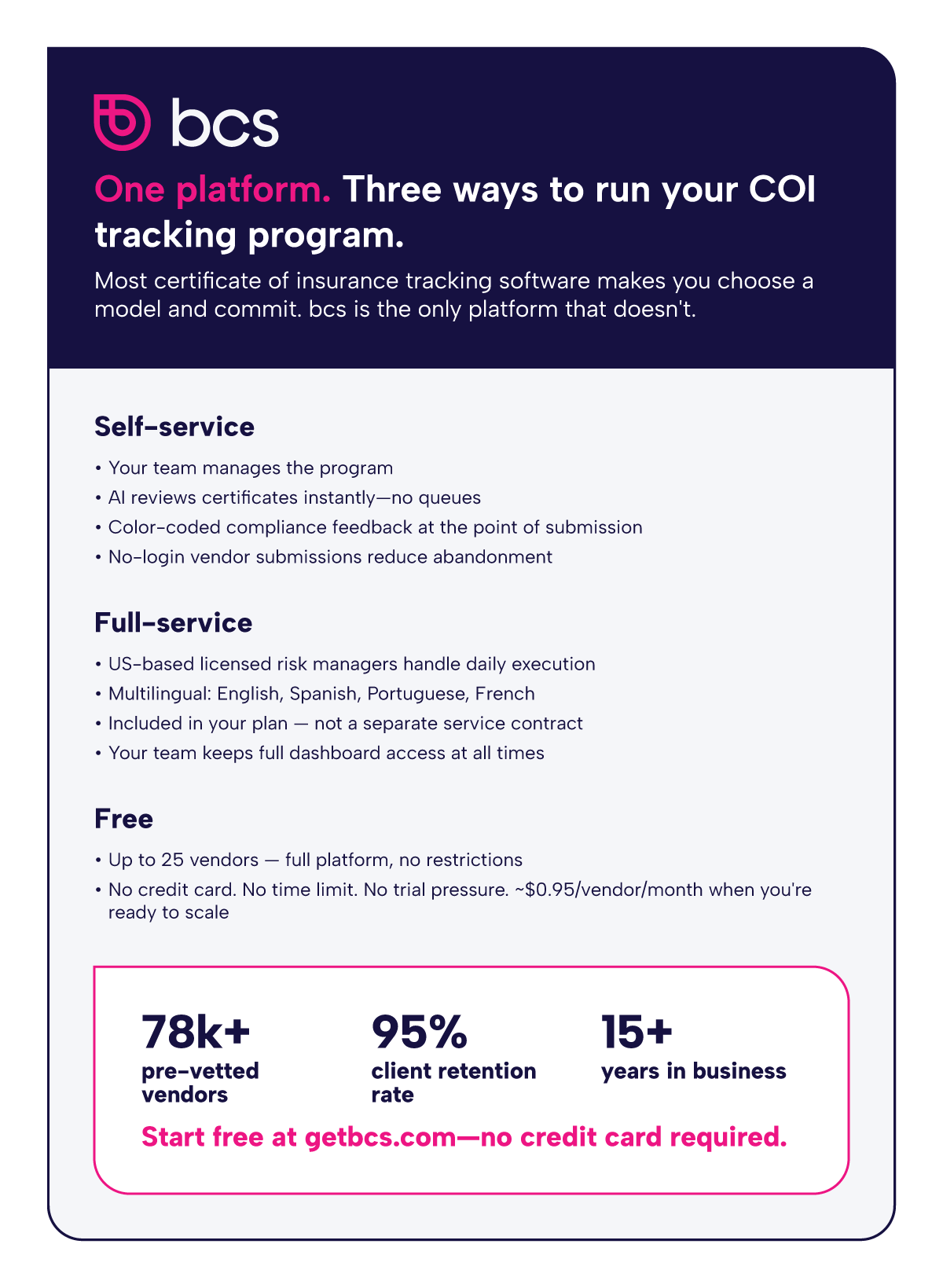
Most COI tracking software is built around a single delivery model—either self-service, where your team manages the platform, or full-service, where the vendor's team manages it for you. bcs is the only COI tracking software that offers both models plus a true freemium tier covering up to 25 vendors at no cost, all within the same platform. Switching between models doesn't require migrating data or re-onboarding vendors—it's a settings change, not a system change.
This article explains what each model really means in practice, where buyers run into trouble with a forced choice, and what a platform that doesn't require that tradeoff looks like.
Certificate of insurance tracking isn't a single product, but a spectrum of services, and where you land on that spectrum should fit your team, not the vendor you happened to evaluate first.
What full-service and self-service COI tracking software models actually mean
Self-service: your team manages the program, automation handles the volume
In a self-service model, your team owns the compliance program. You set the coverage requirements, review flagged exceptions, and make the calls on borderline certificates. The platform handles the volume: collecting documents from vendors, running automated compliance checks, tracking expirations, and surfacing what needs attention.
A good self-service platform means your team isn't reading every certificate manually; the system identifies what's expired, what's missing, and what doesn't meet requirements, and your team acts on exceptions rather than the whole queue. The advantage is control and visibility. The tradeoff is ownership: someone on your staff has to manage the program and handle the judgment calls that automation surfaces but can't resolve on its own.
Full-service: a compliance team manages it for you
Full-service flips the ownership model entirely. In full-service COI tracking the COI tracking company collects certificates, reviews them against your requirements, follows up on non-compliance, and routes exceptions to you for approval. You set the standards. They execute.
The advantage is capacity: a full-service provider absorbs vendor volume that would require multiple internal hires to match. The tradeoff is dependency on the provider's turnaround times, service agreements, and platform. If the work happens in a system your team doesn't access directly, your visibility into compliance status is only as good as the reports they send you.
The cost of locking into the wrong delivery model
When self-service backfires
Self-service works when your team has the capacity to own compliance oversight. It fails when that capacity is overestimated. Even a well-automated platform still requires someone to review flagged items, respond to vendor questions, and handle exceptions automation can't resolve. For programs tracking 200 or more active vendors, that's not a marginal time commitment.
The failure pattern is predictable: vendor volume grows, certificate complexity increases, the queue backs up, the person managing it leaves. The "self-service" model suddenly requires a full-time hire to stay current—the cost arrived on a delay, inside a staffing gap.
The labor arithmetic is direct: manual and under-automated COI tracking consumes 15–20 hours per week for most compliance programs. A self-service platform that's inadequately staffed doesn't eliminate that burden, but moves it to a different interface.
When full-service creates dependency
Full-service solves the capacity problem and can create a different one. When a managed-service provider operates on a proprietary system, your compliance data, including certificate history, vendor records, exception logs, lives on their platform, not yours. Switching providers means rebuilding your compliance history from scratch, not just renegotiating a contract.
The financial risk is structural: full-service contracts priced on volume scale up with your roster but may not scale down as easily. A program your team can't access directly is one your auditors and insurers will ask about that you can't answer without going through the provider.
Why most platforms don't offer a way out
Most COI tracking vendors build around one model and treat the other as an afterthought: a different pricing tier, a different support team, sometimes a different system entirely. A company that selects a self-service platform and then loses compliance staff isn't just understaffed; they're on the wrong platform. Moving to a managed service means a data migration, vendor re-onboarding, and a coverage gap during the transition.
The table below shows where most platforms land across the criteria that matter. bcs is the exception in the last row.
How bcs delivers all three models in one platform
bcs has operated in the COI tracking market for more than 15 years. The platform is built on a straightforward observation: the model that fits a team today is rarely the same one that fits them three years from now. All three delivery models live inside the same bcs account—with a 95% client retention rate behind the approach.
The self-service tier: RiskBot AI and instant compliance review
Two distinct technologies power bcs' self-service capability. AI-powered OCR technology reads and extracts data from incoming certificates. RiskBot AI—bcs' autonomous compliance agent, launched in March 2025—automates tedious administrative tasks, working for you 24/7.
You get real-time responses to your COI and vendor insurance compliance questions while bcs’ AI-powered platform applies logic to insurance data: interpreting policy language, identifying coverage gaps, and flagging deficiencies without a human trigger. The result is instant, color-coded feedback at the point of submission. No queue. No 24–48 hour review window.
Vendors submit certificates via a direct link—no account creation, no portal login, no navigation that creates abandonment before the document is submitted. Reducing submission friction is one of the most reliable levers for improving compliance rates, and it's a difference most platform demos don't surface.
The full-service tier: US-based licensed risk managers
bcs' full-service option puts the day-to-day compliance work in the hands of US-based, licensed insurance professionals—not offshore support, not a generalist customer service tier. These are certified risk managers who understand GL requirements, workers' comp endorsements, additional insured language, and the compliance nuances that vary by industry and jurisdiction.
They cover English, Spanish, Portuguese, and French, and are available 24/7.
This support is included in bcs' pricing. It’s not a premium add-on, or a separate service contract. Because it runs on the same platform as the self-service tier, your team retains full dashboard access to vendor records, certificate history, and flagged exceptions at all times. When your auditor or insurer asks about a specific vendor's compliance status, you can answer directly—not through a service level agreement.
The freemium tier: a real compliance program, not a preview
bcs' free COI tracking tier covers up to 25 vendors with full platform access. No credit card. No time limit. No feature restrictions. For smaller property managers, construction firms managing a handful of subcontractors, or teams piloting COI tracking before committing to a vendor, this is a complete compliance program. At approximately $0.95 per vendor per month on paid plans, scaling past 25 vendors is a cost adjustment on the same platform; vendor data, compliance history, and program settings stay in place.
How to decide which model your team needs right now
Four variables determine the right fit: vendor volume, available staff capacity, compliance requirement complexity, and program stability over the next year or two:
- How many active vendors are you tracking? Below 25, bcs' free tier is a complete program. Between 25 and several hundred with stable requirements, self-service with solid automation works with minimal staffing. Above that—or with frequent vendor turnover—the labor math on full-service often improves against internal headcount.
- What is your team's actual compliance bandwidth? Not theoretical capacity—the realistic one, accounting for competing priorities and coverage gaps. A vendor queue that sits unreviewed for three days is already a self-service program that's understaffed.
- How complex are your certificate requirements? Standard GL limits and straightforward additional insured language are self-service territory. Project-specific endorsements, multi-jurisdiction workers' comp, or carrier-level limitations benefit from a licensed reviewer who works with these documents daily.
- How stable is your program? Recent staff turnover, a growing vendor roster, or expansion into new markets all increase the value of model flexibility. A platform that lets you shift between self-service and full-service COI tracking without migrating data protects your program against the organizational changes you can't fully predict at signing.
bcs' 98,000+ pre-vetted vendor network reduces startup friction for whichever model you choose. If a vendor is already in the network, their data transfers without a collection cycle.
For COI tracking in construction specifically, the complexity of endorsement requirements and project-specific additional insured language typically pushes programs toward full-service or hybrid staffing faster than property management programs at the same vendor volume.
Stop choosing between a COI tracking platform that fits your model and one that can grow with your program. Try bcs free, up to 25 vendors, full platform access, no credit card required. Start free at getbcs.com
Prefer to hand the program to licensed experts? Schedule a demo to see how bcs' full-service COI tracking works—staffed by US-based risk managers, included in your plan, not an add-on. Request a full-service demo
Frequently asked questions