

Summary: The average hospital manages 1,300+ vendor relationships, and 70% of certificates are non-compliant when first received. Learn why automated healthcare vendor insurance compliance is one of the most overlooked risk management functions in the industry—and how AI-powered COI tracking fixes it. Healthcare COI tracking is the process of collecting, verifying, and monitoring vendor insurance certificates to ensure hospitals remain compliant with risk management and regulatory requirements.
Why do hospitals need vendor insurance compliance tracking?
A vendor representative is in the OR during a complex implant surgery. A cleaning crew mops the hallway outside the ICU. An IT company connects to the hospital's network. And a construction crew breaks ground on a new patient wing.
Each scenario is routine. Each vendor, if uninsured or underinsured, is a financial and legal problem waiting to happen.
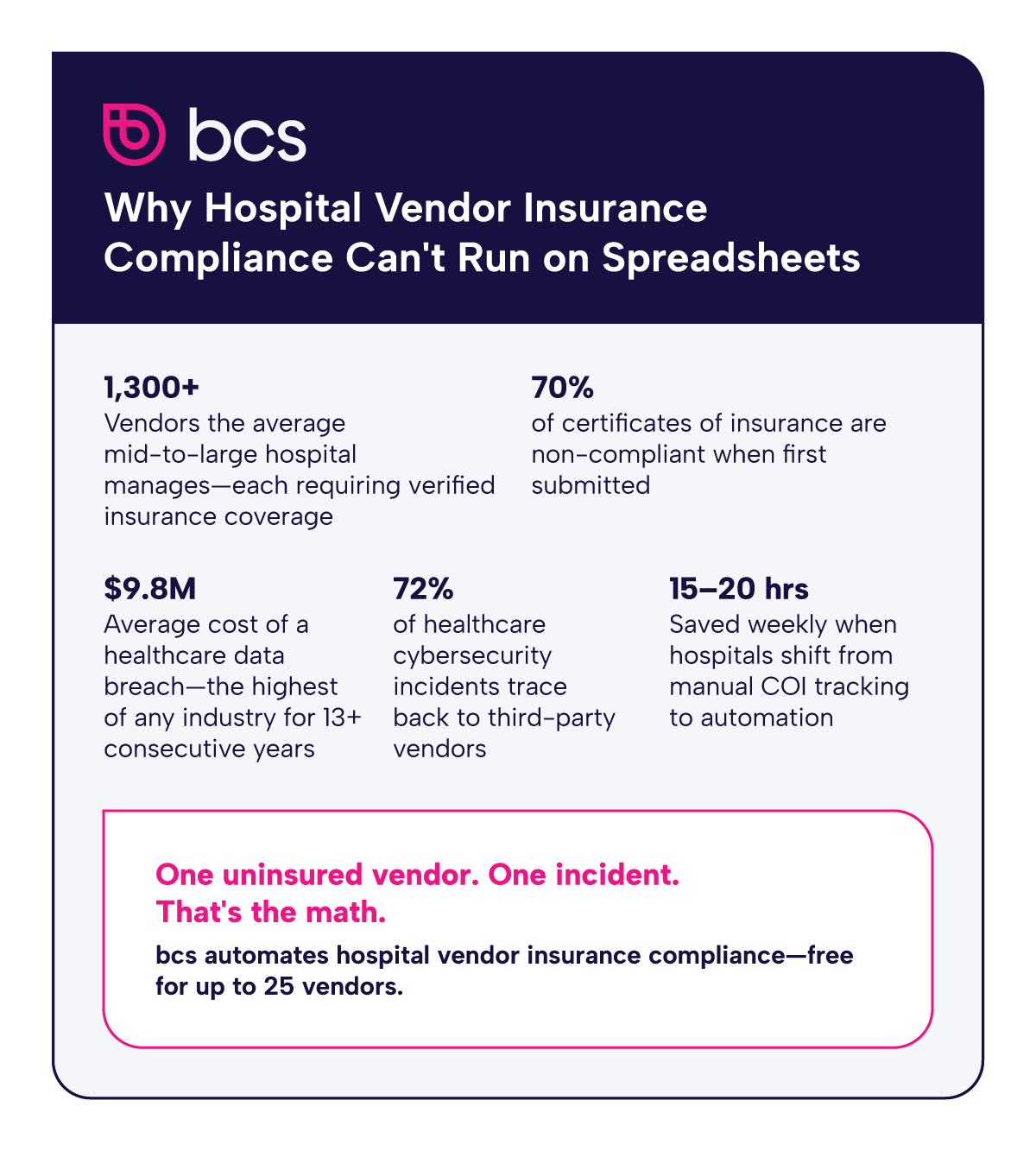
For hospital risk managers, healthcare certificate of insurance tracking is one of the most overlooked—and most consequential—compliance functions in the building. The average mid-to-large hospital manages relationships with more than 1,300 vendors spanning clinical services, facilities, technology, food service, medical waste, logistics, and beyond.
Every one of those relationships carries liability exposure. And that exposure flows directly to the hospital when a vendor's insurance is inadequate, expired, or missing key endorsements.
For hospital risk managers and compliance officers, this operational reality can quickly become a nightmare when you're still managing hospital insurance tracking manually through spreadsheets and email.
The Vendor Ecosystem Behind Hospital Insurance Tracking
Think about how many outside parties touch a hospital in a single day. Surgical device reps physically present during procedures. Travel nurses from staffing agencies. Outsourced anesthesiology, radiology, and dialysis departments. IT vendors with deep access to electronic health records. HVAC technicians, cafeteria contractors, medical waste handlers, and valet services.
Each category carries its own risk profile—and its own insurance requirements.
Clinical vendors create direct patient safety exposure. Wrongful death lawsuits in clinical settings regularly reach high six- to seven-figure payouts, and hospitals can be held vicariously liable when patients reasonably believed a vendor was acting as a hospital representative. IT and technology vendors now represent a rapidly growing risk category: recent studies suggest that about 72% of healthcare data breaches originate with third‑party vendors.
Construction and facilities vendors bring their own hazards. Construction workers face some of the highest injury and fatality rates in the U.S. economy, and under OSHA's multi-employer worksite doctrine, a hospital acting as the controlling employer on a project can be cited for safety violations created by contractor employees. That means even a single uninsured subcontractor working in an active patient corridor can draw OSHA's attention squarely to the hospital.
Here's the reality most risk managers know but don't say aloud: the certificate on file looked fine, but the policy behind it was already gone.
This is what happens when a static document—accurate the day it was issued—sits in a filing system with no one monitoring what changed the day after.
What Coverage Does Vendor COI Tracking Need to Cover?
The coverage requirements alone should give any risk manager pause. Not because they're complicated, but because the combination of coverage types, minimum limits, required endorsements, and renewal timing across 1,300+ vendors creates a compliance burden that no spreadsheet was built to handle.
Start with the baseline. Nearly every vendor needs Commercial General Liability—$1 million per occurrence, $2 million aggregate (though it varies from state by state)—with the hospital named as additional insured on a primary, non-contributory basis.
Then it gets more specific. Any licensed vendor with patient contact—outsourced clinical staff, lab services, anesthesiology groups—needs Professional Liability at $1–3 million. The catch that manual processes routinely miss: that coverage must be maintained for the full contract term plus three years after termination. Tail claims in healthcare don't always surface immediately. By the time a lawsuit arrives, the vendor may have changed carriers twice. If no one tracks the tail requirement, the hospital absorbs the exposure.
Cyber Liability is where healthcare splits from every other industry. Most health systems now require business associates to carry $2–5 million in cyber coverage—for good reason. A single vendor breach can compromise millions of patient records and trigger HIPAA fines up to $1.9 million per violation category per year. All carrier policies must hold an AM Best rating of A– or better.
High-risk vendors—construction firms, large staffing agencies, and clinical contractors—are often required to carry umbrella or excess liability coverage that brings their total limits to at least $5 million, sitting above their primary general liability, auto, and employer's liability policies.
That's four distinct coverage types, each with its own limits, endorsements, and renewal timeline. Multiply that across 1,300 vendors, and the compliance math gets punishing fast.
Some common required insurance policies for hospital vendors are:
- General liability insurance
- Workers’ compensation
- Professional liability
- Cyber liability
- Auto liability (for transportation vendors)
Manual COI Tracking Can't Keep Up at Hospital Scale
Consider what happens at a 480-bed regional medical center in the Southeast. During a wing renovation, a subcontractor's workers' compensation policy was renewed, and the carrier changed the policy number. The certificate on file was technically valid when submitted. Months later, an on-site injury triggered a workers' comp claim. By the time the adjuster traced the policy change, the hospital had already spent weeks in legal back-and-forth that a real-time compliance system would have flagged on Day 1.
That scenario plays out in some variation everywhere manual tracking is the standard. Industry data confirms it:
- 70% of certificates are non-compliant when first submitted
- 3 follow-ups required per certificate to reach full compliance
- 60–70% compliance rate ceiling for manual systems—meaning hundreds of active gaps in any hospital managing 1,300 vendors on a given day
The expiration problem is structural. A COI is a static document. Once it's filed, it doesn't update. A vendor's policy can be cancelled, endorsements dropped, or coverage limits reduced without the hospital knowing—until the next renewal chase surfaces it, or until an incident makes it unavoidable. That gap is where liability quietly accumulates.
Organizations that switched from manual to automated COI tracking consistently reported compliance rates jumping from the low 20–40% range to 90%+ within weeks. Time savings averaged 15–20 hours per week for risk management teams—hours redirected from chasing expiration notices to meaningful risk analysis.
A Smarter Approach: Healthcare COI Tracking Software Built for This Complexity
bcs was built for exactly this kind of complexity—hundreds of vendors, multiple coverage types, and a compliance gap that gets wider every day manual tracking stays in place.
Here's how it works in practice.
A vendor submits a certificate through bcs's no-login portal—no account creation, no credentialing friction, no back-and-forth. The moment it's uploaded, bcs's proprietary OCR engine reads it.
Within seconds, RiskBot AI—bcs's autonomous compliance agent—interprets the policy details, cross-references every data point against your stored requirements, and delivers an instant verdict with color-coded feedback.
Compliant? The vendor is approved and expiration tracking starts automatically. Deficient? RiskBot identifies the exact gap—wrong coverage limit, missing endorsement, wrong named insured—and triggers an automated follow-up to the vendor without anyone on your team lifting a finger.
As policies approach expiration, RiskBot sends renewal reminders at 60, 30, and 15 days out. No response from the vendor? Your risk team gets an escalation alert. Certificate lapses entirely? The vendor is automatically flagged and removed from your active approved list. Your staff sees all of it in a centralized compliance dashboard — real-time, fully auditable, and ready the moment a Joint Commission surveyor walks through the door.
The platform's 98,000+ vendor network means many of your existing vendors are already pre-verified in the system, cutting onboarding time significantly. And bcs's freemium plan gives hospital risk teams full access to every feature — at no cost for up to 25 vendors:
- RiskBot AI autonomous compliance agent
- Proprietary OCR technology for instant certificate reading
- Automated renewal reminders at 60, 30, and 15 days
- Centralized vendor COI tracking dashboard
No trial period. No credit card. No pressure to upgrade before you're ready.
Try bcs premium free and see exactly how much manual COI tracking is costing your business right now. No credit card required. No complicated implementation. Just upload your current vendor certificates and watch automated tracking start protecting your bottom line immediately.
FAQs