

Summary: Jones is a deliberate vertical platform, purpose-built for CRE and construction, which means multi-industry organizations aren't an afterthought—they're simply outside the product's scope. bcs covers 12+ industries from a single configurable platform, with AI-powered OCR that returns color-coded compliance feedback in 30 seconds, RiskBot as a 24/7 compliance AI assistant that keeps your team informed between document reviews, and a true freemium tier that doesn't require a sales call to access.
Jones made a deliberate choice. Their own blog states it plainly: Jones serves commercial real estate and construction—and for now, nothing else. That's a product strategy, not a gap in the marketing copy.
For a property management firm or a general contractor, that focus probably works fine. But if your organization manages vendor compliance across healthcare, retail, manufacturing, or hospitality—or any combination of industries—Jones wasn't built for you. The platform's compliance ruleset, endorsement index, and pricing structure are engineered around two verticals. Everyone else falls outside the model entirely.
That's the problem driving most searches for a Get Jones alternative. What follows is a direct look at where the vertical limitation creates real operational risk. And what a multi-industry platform needs to do instead.
Key Takeaways
- Jones explicitly serves commercial real estate and construction only. Organizations with vendor portfolios that span other industries are operating outside the platform's designed scope.
- Multi-industry compliance requires industry-specific rulesets, not a single template applied broadly—healthcare, manufacturing, and franchise operations each carry compliance frameworks that a CRE-and-construction architecture wasn't built to handle.
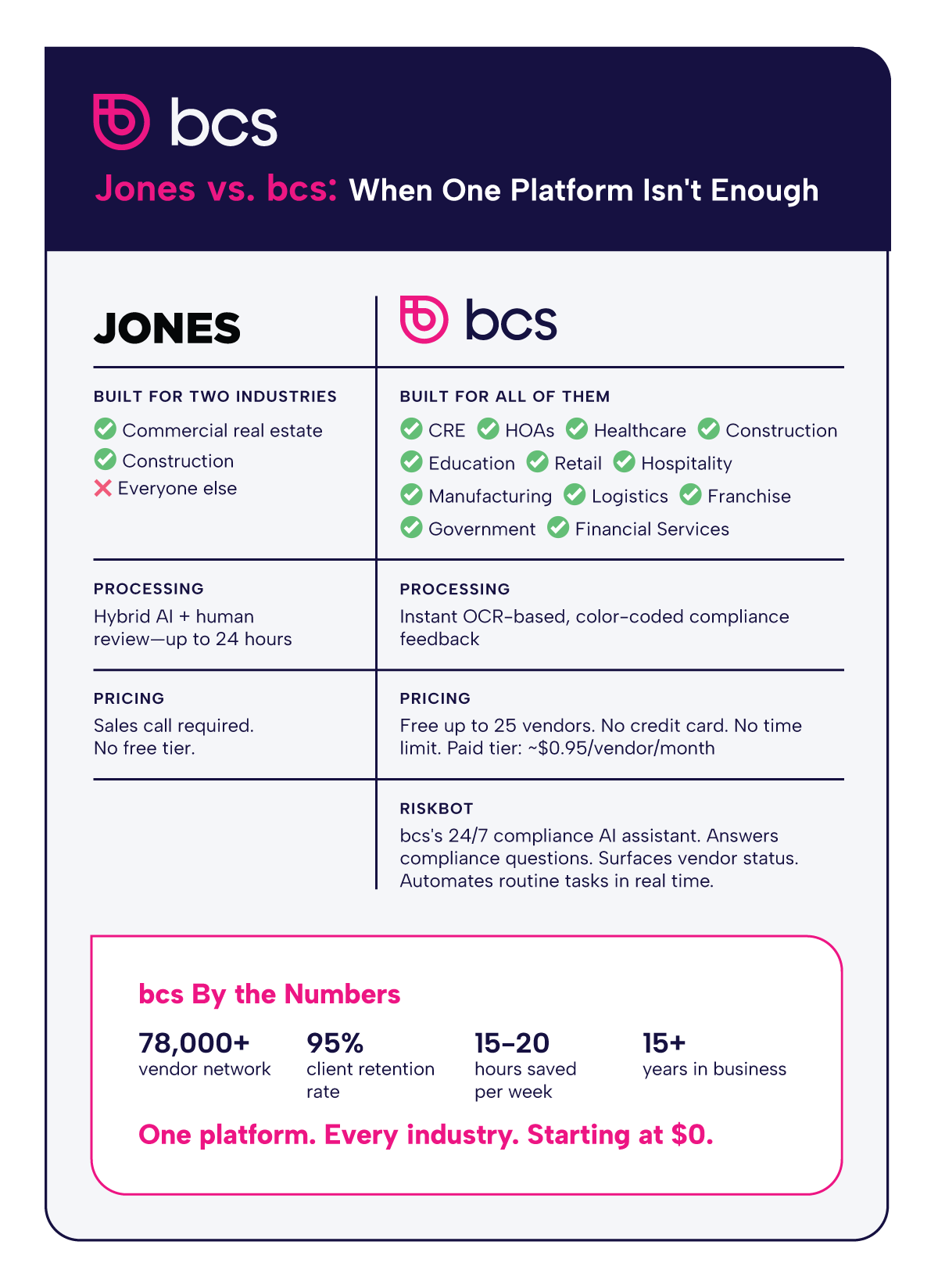
- Jones routes certificates through a hybrid review cycle that can take up to 24 hours; bcs delivers instant, color-coded compliance feedback the moment a vendor uploads a certificate.
- RiskBot, bcs's 24/7 compliance AI assistant, answers compliance questions, surfaces vendor status updates, and automates routine workflow tasks in real time—running alongside your team between document reviews.
- Jones requires a sales conversation before you see pricing or the product, while bcs offers a true freemium tier for up to 25 vendors with no credit card and no time limit.
Why Multi-Industry Operations Outgrow Vertical Platforms
A national franchise operator managing restaurant vendors, construction contractors, and third-party cleaning services doesn't have one set of certificate of insurance requirements. They have three. And those requirements may vary by state, property type, and contract terms. The compliance ruleset that governs a subcontractor on a job site bears almost no resemblance to the one that governs a food service supplier rotating through 40 locations quarterly.
Jones's platform is designed around a specific compliance architecture: subcontractor endorsements for construction and tenant insurance for commercial real estate. Their endorsement index spans more than 1,800 entries across general liability, business owner policy, automobile, and workers' compensation policy types. This means genuine depth for the verticals they serve, but that coverage stops precisely where multi-industry organizations need it to begin.
The practical consequence: organizations with multi-industry vendor pools that adopt a vertical-only platform like Jones end up managing two systems: one for the industries the platform supports, one for everyone else. Two systems means two workflows, two audit trails, two places for something to fall through.
Most teams that end up there started with a spreadsheet and a COI tracker. They just upgraded one and kept the other.
The Compliance Requirements Jones Wasn't Designed to Handle
Multi-industry COI tracking isn't just accepting certificates from a wider range of vendor types. The requirements underneath the surface are substantially different.
Healthcare organizations need cyber liability and professional liability tracked alongside standard GL and workers' comp, and HIPAA compliance governs how that data is stored and accessed. Systems handling vendor credentialing for hospital networks also need to align with Joint Commission readiness requirements.
Those aren't optional fields to add to a commercial real estate template; they're a fundamentally different compliance framework.
Manufacturing operations managing a supply chain of 300+ vendors across multiple facilities face compliance rules that vary by location, not just vendor category. Certificate requirements for a vendor servicing a plant in Texas differ from those servicing a warehouse in New Jersey. A system configured around property type and subcontractor classification—Jones's core architecture—doesn't accommodate that kind of geographic and operational variability.
Retail and franchise operations add volume pressure on top of complexity. Seasonal contractors cycle in and out quarterly. Vendor onboarding happens at scale across dozens of locations simultaneously. That's where manual insurance tracking breaks fastest—and where a platform built for one vertical leaves the rest of the business exposed.
What Multi-Industry COI Tracking Actually Requires
Multi-industry COI tracking requires something vertical platforms aren't built to deliver: a configurable compliance ruleset that adjusts to the specific regulatory framework governing each vendor relationship. These aren't variations on a single template—they're fundamentally different compliance programs running in parallel.
- Healthcare vendors carry HIPAA-aligned coverage requirements and Joint Commission readiness standards
- Manufacturing vendors face compliance rules that vary by facility location, not just vendor category
- Franchise and retail operations onboard seasonal contractors at volume across dozens of locations simultaneously
bcs is built as a horizontal platform—configurable across industries rather than optimized for two of them. Construction, CRE, healthcare, education, retail, hospitality, manufacturing, logistics, franchise, HOAs, government, and financial services are each supported with industry-specific knowledge bases aligned to the regulations that actually govern them.
A healthcare system using bcs configures requirements separately for surgical equipment vendors, janitorial contractors, and IT service providers. Requirements vary by location, project, vendor category, and contract terms. One compliance program. No workarounds.
The processing speed gap is real. Jones routes certificates through a hybrid AI-plus-human review cycle that can take up to 24 hours. bcs's AI-powered OCR technology scans each incoming COI against your requirements—coverage limits, endorsements, expiration dates, additional insured status—and returns color-coded compliance feedback in 30 seconds. For an organization running active vendor onboarding across multiple business units, that difference affects how quickly a non-compliant vendor gets flagged and how quickly a delayed project gets cleared.
RiskBot runs alongside that process as bcs' 24/7 compliance AI assistant. Between document reviews, it answers compliance questions, surfaces vendor status updates, and automates routine workflow tasks in real time—so your team isn't starting from scratch every time they need to know where a vendor stands.
Jones Has No Free Trial. bcs Starts at $0.
Jones pricing requires a sales conversation. No free tier. No self-serve option. No way to put the platform through its paces before signing a contract. For a multi-industry operation evaluating several platforms simultaneously, that friction adds weeks to the decision cycle. And it means the first time you see the product in production is after you've already committed.
bcs, on the other hand, offers a true freemium tier—up to 25 vendors, no credit card, no time limit. And you enjoy all the premium features. The paid tier starts at approximately $0.95 per vendor per month. Every tier includes unlimited users and integrations with Procore, MRI, Yardi, and other platforms at no additional cost.
The pricing transparency matters beyond the dollar figure. A platform that requires a sales call before showing you the price has something to negotiate. bcs publishes its rates and lets you start for free—because a freemium model only converts if the product earns it.
RELATED: “myCOI Alternative: Why bcs Is Better”
One Platform for the Whole Operation
Jones is a well-funded, credible platform that does what it says, for commercial real estate and construction. If your entire vendor portfolio lives in those two verticals, this comparison looks different.
Most organizations don't have that clarity. Risk doesn't stay in one industry. Vendors move across business units. Compliance requirements compound across every property, project, and service relationship the organization manages. A platform that covers two industries well leaves the rest of the operation untracked. And untracked is where claims happen.
bcs has tracked vendor insurance compliance for 15+ years across a network of 98,000+ vendors and holds a 95% client retention rate, meaningful in a category where switching costs are real and churn is the norm. Organizations that consolidate their compliance program on one platform recover 15–20 hours a week that would otherwise go to chasing certificates across disconnected systems.
One expired certificate in the wrong place is all it takes. The platform covering your whole operation is the one worth evaluating.
Try bcs premium free and see exactly how much manual COI tracking is costing your business right now. No credit card required. No complicated implementation. Just upload your current vendor certificates and watch automated tracking start protecting your bottom line immediately.
FAQs About GetJones Alternatives