

What the two approaches really cost — in time, risk exposure, and missed expirations.
COI tracking is the process of collecting, reviewing, and monitoring certificates of insurance to confirm that vendors, contractors, or tenants maintain required coverage throughout an active business relationship.
Manual COI tracking relies on spreadsheets, email chains, and staff-driven document reviews; automated COI tracking uses software to request, collect, validate, and flag certificates without manual intervention.
The distinction matters because manual processes leave organizations exposed to coverage gaps, missed expirations, and audit failures that automated certificate of insurance tracking software is specifically designed to prevent. Teams managing more than a few dozen vendors—in construction, property management, or any vendor-heavy operation—typically reach a decision point when manual tracking can no longer scale.
COI tracking software replaces manual certificate collection and review with automated workflows that validate vendor coverage in real time and flag expirations before they create liability exposure. Teams that switch from manual to automated COI tracking software recover up to 15–20 hours per week previously spent chasing documents and reviewing certificates by hand. The cost difference isn't just labor, but the coverage gaps that spreadsheets and email reminders routinely miss.
This post breaks down what each approach costs, where manual processes fail first, and what to look for when evaluating certificate of insurance tracking software.
What manual COI tracking actually costs
Manual COI tracking has a labor cost that's easy to see and a liability cost that's easy to miss. Most teams focus on the first. The second is where real exposure lives.
The labor math most teams underestimate
Collecting certificates by email, logging them in a spreadsheet, following up with non-responsive vendors, manually cross-referencing expiration dates against active rosters—each step is low-stakes in isolation. Across a vendor list of any meaningful size, they compound fast.
- Risk and compliance teams using manual processes spend up to 15–20 hours per week on certificate management alone.
- At a fully burdened labor rate of roughly $45 per hour, teams spending 15–20 hours per week on COI management spend about $41,000 per year on a process that still produces compliance gaps.
The math gets worse at scale. A team managing 50 vendors can absorb those hours. A team managing 200 cannot, and a team managing 500 is structurally unable to do it manually without dedicated headcount or persistent gaps in coverage.
The cost the spreadsheet doesn't show
When a vendor with a lapsed policy causes property damage, injures a worker, or triggers a third-party claim, the contracting organization can find itself absorbing losses it expected the vendor's insurance to cover.
Industry data from NCCI’s Workers Compensation Statistical Plan shows that the average cost for all claims combined for accidents that occurred in 2022-2023 was $47,316, with some types of claims averaging over $90,000. When an uninsured or underinsured subcontractor’s worker is injured, those same cost levels can shift to the general contractor or property owner through statutory and contractual liability.
Manual tracking doesn't eliminate that exposure. It creates the impression of managing it.
Where manual processes break down
Manual COI tracking doesn't fail all at once. It fails at the edges: the vendor whose renewal slipped past a busy week, the certificate buried in a shared drive subfolder, the additional insured endorsement never requested on the original submission. Each of those failures looks small in isolation. The claim exposure they create is not.
The expiration gap problem
The expiration gap is the window between when a certificate expires and when the tracking team discovers it. In a manual system, that window can stretch days or weeks—during which the vendor may be actively working on a project or accessing a property without current insurance in place. One incident during that window produces the kind of claim no spreadsheet can prevent after the fact. A manual system depends on someone checking expiration dates against active vendor status and sending renewal reminders early enough to receive a response. None of those conditions holds consistently at scale.
Why vendor friction makes the problem worse
Manual COI tracking doesn't just burden the internal team, but the vendors, as well. When vendors must respond to individual email requests, locate their certificate, and reply to the right contact, response rates drop. Compliance rates follow.
Low vendor response rates are rarely a vendor problem. They're a process problem. The more steps between a vendor and a submitted certificate, the lower the completion rate.
What automated COI tracking software does differently
Automated COI tracking software doesn't just do the same job faster, but changes which jobs need to be done at all.
From manual review cycles to instant compliance feedback
Manual review means someone opens a PDF, reads the coverage lines, cross-references required limits, checks additional insured language, and logs the result. For one certificate, that takes 10–15 minutes. For a hundred certificates arriving in the same week, it becomes a backlog.
Automated platforms use OCR technology to read incoming certificates the moment they're uploaded—extracting coverage data, comparing it against defined requirements, and returning results immediately. Compliant certificates clear without human intervention. Discrepancies are flagged with specifics. The team's time shifts from reviewing certificates to handling the exceptions that require judgment.
How AI-powered tracking differs from basic OCR
OCR extracts text from certificate PDFs. That's useful, but text extraction isn't compliance analysis. Basic OCR tells you what the certificate says. AI-powered COI tracking tells you whether what it says meets your requirements, what's missing, and what changed since the last submission cycle.
The distinction matters because certificates aren't static. Policies get endorsed mid-term. Limits get adjusted. Carriers change. A platform that only reviews at upload misses changes that occur between renewal cycles. A platform with AI-driven monitoring catches them.
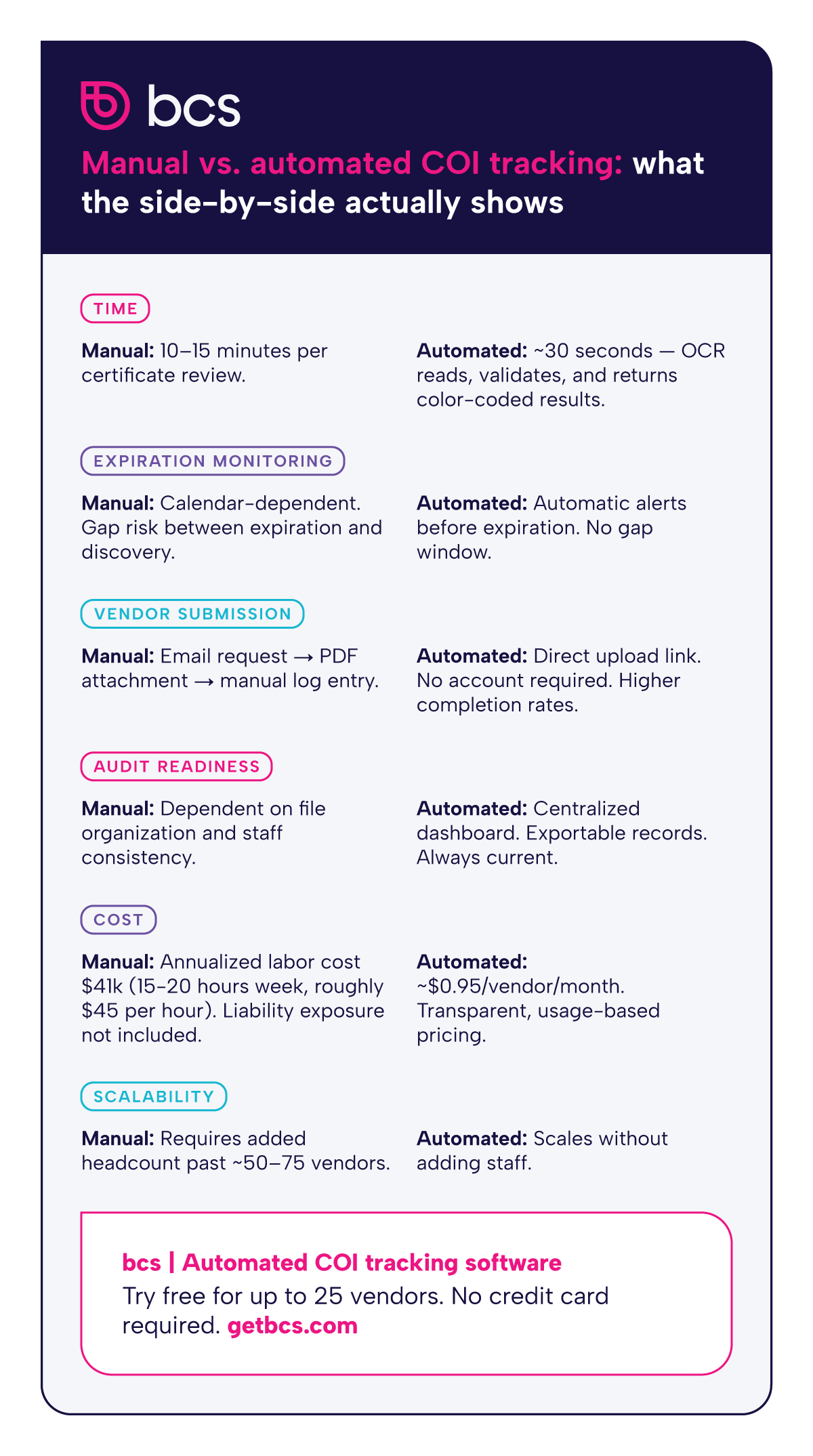
Manual vs. automated COI tracking: side-by-side
The comparison below covers the operational dimensions that matter most to teams making this evaluation.
Manual tracking transfers compliance risk to the internal team. Automated tracking transfers accountability back to the vendor—where it belongs.
How to evaluate COI tracking software
Not all automated COI platforms deliver equivalent results. The criteria below map directly to the failure modes that manual tracking produces. A platform that doesn't address these isn't solving the problem.
Vendor submission experience. If vendors must create accounts or navigate a portal to submit certificates, expect lower completion rates. bcs vendors submit through a direct link—no account creation, no portal login required. That frictionless experience is the difference between a compliance program that runs and one that stalls at the vendor.
Compliance feedback speed. Platforms that return results in 24–48 hours still create review backlogs. bcs's OCR technology reviews incoming certificates and returns color-coded compliance feedback in approximately 30 seconds. Compliant certificates are cleared immediately. Non-compliant ones are flagged with specific gaps identified for action.
AI capability beyond extraction. OCR handles document reading. bcs's RiskBot, launched March 2025, operates as a 24/7 compliance assistant—answering questions about vendor status, executing human-defined workflow rules, and returning compliance summaries on demand. Your team sets the rules and asks the questions; RiskBot handles the follow-through. For teams that need ongoing compliance support and not just upload processing, that distinction is operationally significant.
Not every compliance question has a clean answer in the certificate itself. Unusual endorsement language, multi-jurisdictional requirements, and carrier-specific policy terms are the cases software alone doesn't resolve cleanly. bcs includes US-based licensed insurance professionals at no additional cost—certified COI software available in English, Spanish, Portuguese, and French—for the cases where expert interpretation is what's needed.
Pricing transparency. bcs charges approximately $0.95 per active vendor per month. No fees for human review, no separate charge for API access, no premium tier required for core features. For teams calculating the total cost of ownership against their current manual approach, the comparison is direct.
A real evaluation path. bcs offers full platform access for up to 25 vendors at no cost—no credit card, no time limit. That makes it possible to run a genuine evaluation against live vendors before committing to a paid plan.
For teams managing larger vendor portfolios, bcs' certificate of insurance tracking software serves clients across construction, property management, manufacturing, healthcare, universities, and other vendor-heavy industries—with 95% client retention and 15+ years of operational history.
Stop tracking certificates by hand. Try bcs free for up to 25 vendors—no credit card, no time limit, no catch. Start free at getbcs.com
Ready to see what automated COI tracking looks like at your scale? Schedule a demo to see how bcs handles your specific vendor mix and compliance requirements.
Frequently asked questions