

Construction projects valued at $10 million or more frequently use consolidated insurance programs—OCIPs (Owner-Controlled Insurance Programs) or CCIPs (Contractor-Controlled Insurance Programs). These "wrap-up" policies bundle general liability, workers' compensation, and builder's risk coverage under one master policy, which sounds like an administrative dream. One policy. Multiple contractors. Simplified compliance.
Except it's not that simple.
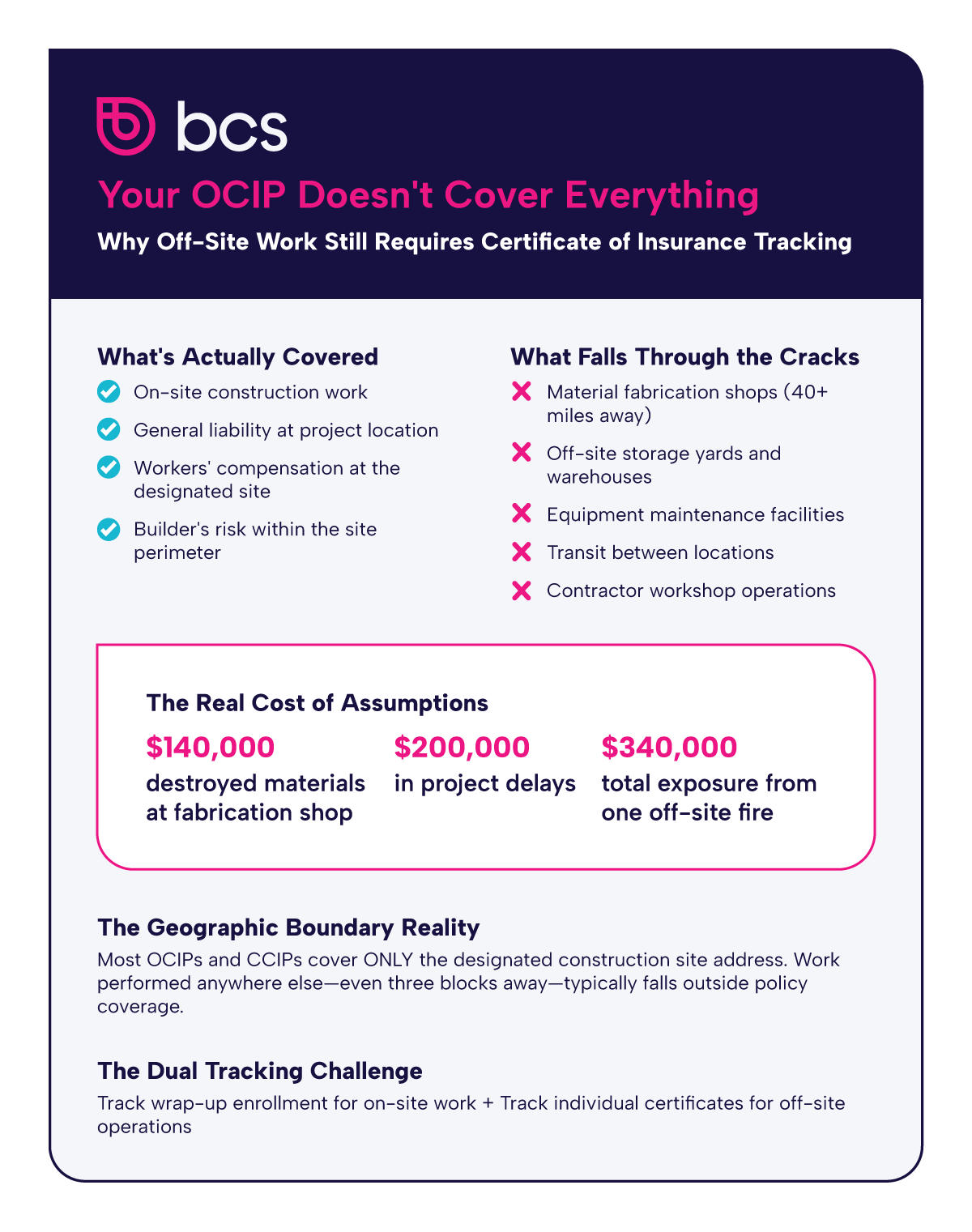
Most OCIPs and CCIPs cover only incidents occurring at the designated construction site. Your contractor fabricating custom architectural concrete panels 40 miles away in their shop? That facility falls outside the policy's scope. The specialized metalwork being prepared in an off-site workshop? Not covered. Materials stored at a contractor's warehouse before delivery to the job site? Outside the policy boundaries.
This creates a compliance challenge that many project owners don't anticipate: Certificate of insurance tracking doesn't disappear when you purchase wrap-up coverage. It shifts. You still need to verify and track contractor insurance, just for different activities than you originally expected.
The Geographic Boundary Problem in Construction Nobody Explains Clearly
Insurance carriers define "on-site" with precision that matters more than most project sponsors expect. The policy specifies an exact physical address—your construction location—and coverage extends only to that defined perimeter.
Not "within a reasonable distance." Not "related to the project." Not "if the work eventually gets installed on-site."
The actual construction site. That's it.
This creates problems because modern construction doesn't happen in one neat geographic package. A hospital expansion, for instance, could have 23 different subcontractor COI requirements, 11 of them performing critical work at locations scattered across three counties—all technically off-site despite being essential to the project.
The structural steel fabricator may operate a shop 60 miles north. The precast concrete manufacturer may cast panels at a facility two states away. The custom casework contractor may maintain a 15,000-square-foot workshop where crews have spent six weeks building nurse stations, reception desks, and specialized medical cabinetry.
Every hour those crews worked at off-site locations fell outside the project's OCIP coverage. Many project managers don't discover this until something goes wrong.
When Off-Site Work Becomes Expensive
A mechanical contractor may learn this distinction to the tune of $340,000 lesson. Imagine his crew was fabricating custom HVAC ductwork at an off-site shop—precision work requiring three weeks to complete. An electrical short started a fire overnight. The blaze destroyed $140,000 worth of completed ductwork and raw materials.
The project's OCIP denied the claim immediately. Off-site incident. Outside coverage territory.
The contractor's own general liability policy had lapsed three weeks earlier—nobody had been tracking his certificate of insurance because everyone assumed the wrap-up provided complete protection.
The project owner absorbed the loss. Timeline delays added another $200,000 in costs. But that scenario plays out smaller every day across construction projects.
Here's what we see repeatedly:
A glazing contractor stores $80,000 worth of custom curtain wall panels at their warehouse while waiting for the building envelope to reach installation readiness. Severe weather damages the panels. The OCIP doesn't respond because the loss occurred at a storage facility, not the construction site. The contractor's property insurance had a $50,000 deductible that nobody verified.
These aren't exotic edge cases. They represent standard construction operations that wrap-up policies consistently exclude.
The Dual Tracking Nightmare
Managing compliance when some work falls under your OCIP or CCIP while other activities require individual contractor policies creates administrative complexity that manual processes can't handle.
You're essentially running two parallel compliance programs simultaneously:
Track one: Verify that contractors are properly enrolled in your wrap-up program for on-site work, confirm they've provided accurate bid credits removing insurance costs from their proposals, and ensure they understand which activities the master policy covers.
Track two: Collect, verify, and monitor certificates of insurance for all off-site operations, including commercial auto coverage, pollution liability for off-site material handling, professional liability for design work performed at contractor offices, and property coverage for materials stored at off-site locations.
Now multiply that across 40, 60, or 80 contractors. Each contractor might need 2-5 separate certificates depending on their scope. Each certificate has different expiration dates, different carriers, different coverage limits, different endorsement requirements.
A spreadsheet tracking this becomes a maze of conditional formatting, hidden columns, and formulas attempting to answer "Does this contractor need this specific coverage for this specific activity?" The answer changes based on work location, material handling, equipment usage, and timing.
Email reminders get ignored or buried. Expiration dates slip past unnoticed. Someone verbally confirms they "sent the updated certificate" but it never arrives. You discover gaps only when reviewing monthly compliance reports—or worse, when an incident occurs.
How Automated Systems Handle Mixed Coverage Scenarios
Manual certificate of insurance tracking fails because they rely entirely on human memory and vigilance. Someone has to remember which contractors fabricate materials off-site. Someone has to track when their individual policies expire. Someone has to verify that coverage limits meet requirements for both on-site and off-site work.
Automated COI tracking software handles this complexity without the cognitive burden.
Configure your requirements once: specify which activities require individual contractor insurance tracking and which fall under your wrap-up program. The system automatically monitors compliance based on work location and contractor scope.
Stop Assuming Your Wrap-Up Policy Covers Everything
OCIPs and CCIPs reduce insurance costs and standardize on-site coverage. That value is real. But they don't eliminate the need for certificate of insurance tracking. They change where that tracking matters most.
Off-site coverage gaps create the same exposure as having no wrap-up policy at all. One uncovered incident at a fabrication shop, storage yard, or maintenance facility can generate liability exceeding your entire project's insurance savings.
Compare the Top COI Tracking Companies for Construction
bcs Delivers Powerful, Automated COI Tracking for Construction Companies
AI-powered COI tracking software, like bcs’, approaches this through intelligent coverage mapping. Our platform identifies which contractors need individual policies for off-site operations while recognizing that their on-site work falls under your master policy.
RiskBot, our proprietary AI agent, monitors both wrap-up policy compliance and individual contractor certificates simultaneously. The technology tracks renewal dates, verification requirements, and policy limits across all contractors—regardless of whether they're working under your OCIP/CCIP or their own coverage.
Automated renewal reminders reach contractors before policies lapse. Certificate verification happens instantly when contractors upload documentation. You maintain complete visibility into compliance status without manually reviewing documents or tracking dates in spreadsheets.
bcs eliminates the administrative complexity of managing mixed coverage scenarios. Our platform handles both your wrap-up policy compliance and individual contractor certificates, providing complete visibility into your insurance protection—on-site and off-site.
Try bcs Free - Start your free trial today. No credit card required, no obligation. Experience automated COI tracking for construction projects in minutes.
Request a Demo - See how bcs handles complex OCIP/CCIP scenarios. Schedule a personalized demo with our insurance compliance experts.
Questions about your specific project? Contact our US-based support team to discuss how bcs can streamline certificate of insurance tracking for your wrap-up insurance program.