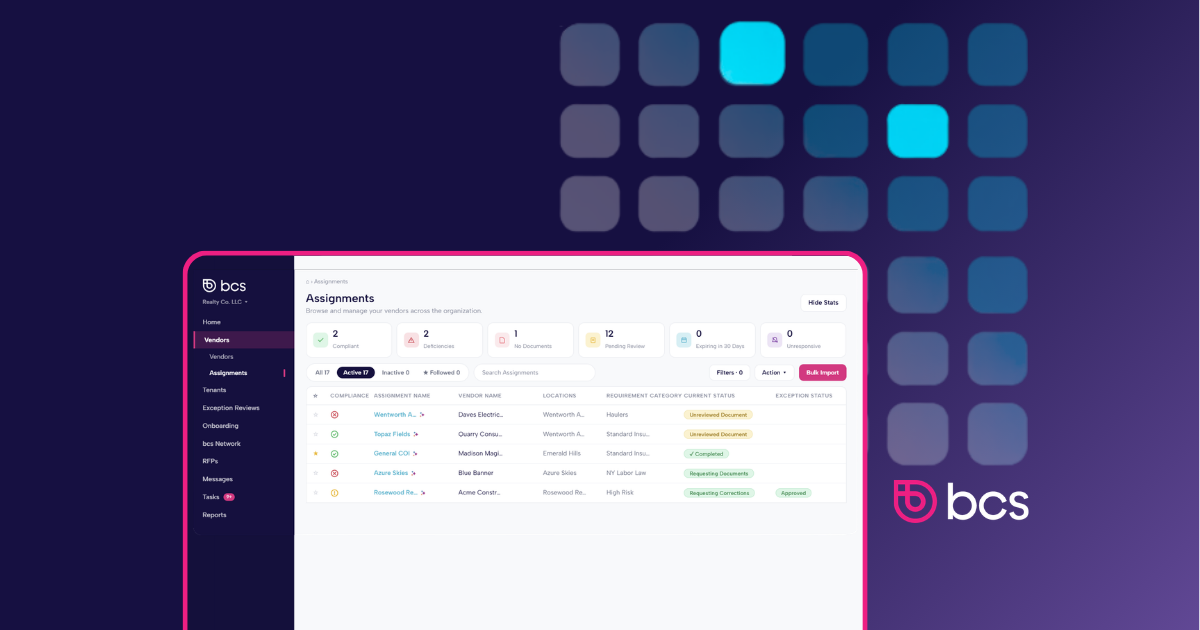
Most compliance reviews stop at the certificate. Ours starts where the real risk lives, in the...
The State of AI-Powered Certificate of Insurance Tracking in 2026
The State of AI-Powered Certificate of Insurance Tracking in 2026
18:37
Every COI platform now runs AI. The four-level framework that's emerged is a useful map, but it stops one level short. Here's the fifth level, and why verifying the read matters more than where the data came from.
TL;DR
- AI in COI review spans five technology levels, not four; the fifth adds an independent check on the read.
- No platform fully automates endorsement interpretation in 2026; complex endorsements still go to humans everywhere.
- Self-reported accuracy numbers (99.9%, 99.5%) measure different things and can't be compared.
- "Source of truth" live data is real only where the agency or carrier is connected, and that footprint is narrower than the headlines suggest.
- The biggest safeguard isn't fresher data. It's a second, independent engine plus a human who adjudicates the disagreements.
AI-powered certificate of insurance review is the use of OCR, natural-language processing, or structured-data integrations to pull policy data off a COI and test it against a set of requirements. By 2026, every major platform (BCS, Jones, illumend, TrustLayer, Certificial, CertFocus, and Billy) uses AI somewhere in that pipeline. The interesting question is no longer whether a platform uses AI. It's what happens when the model is wrong, because on real insurance documents, it sometimes will be.
A widely circulated framework sorts the market into four technology levels, from legacy OCR up to agent-verified structured data. It's a genuinely useful lens, and we'll use it here. But it organizes the market around a single question (how good is the input?) and treats accuracy as something you inherit from your data source. That misses the step where the most consequential errors actually happen and get caught: the verification of the read itself. So we'd add a fifth level. This guide walks all five, then examines the one claim the framework leans on hardest (that you can simply tap "the source of truth") and where that claim breaks in practice.
The five levels of AI-powered COI review
The level a platform operates at sets the ceiling on everything built above it. Levels 1 through 4 each improve the input or its interpretation. Level 5 adds a different thing entirely: verification of the determination.
1
OCR + Rules Engine
~70–80% on clean ACORD forms · legacy
Optical character recognition converts the certificate image to text; a rules engine compares that text to requirements. The foundation of the category.
Where it breaks: reads characters, not meaning. Can't interpret endorsement language, exclusion context, or ambiguity; struggles with poor scans and non-standard layouts.
2
AI / NLP Document Understanding
self-reported 95–99% · most "AI-powered" platforms
NLP and ML models trained on insurance documents interpret language, table structure, and non-standard formats far better than OCR. This is where most platforms marketing "AI" actually sit (e.g. Hawk-I, Lumie, Billy's assistant, and similar single-engine readers).
Where it breaks: it's one model reading one document at one moment. Better at ambiguity than OCR, but when the single engine is confidently wrong, nothing independent catches it.
3
AI + Expert Human Review (Hybrid)
self-reported ~99.5% · full-service teams
AI does a first pass; trained insurance professionals validate the hard cases (Jones's auditing team, myCOI's concierge tier, and full-service models including BCS's). The human is the safety net that catches misread endorsements and ambiguity.
Where it breaks: the safety net is people. It adds hours-to-days of turnaround and is expensive to scale, so it tends to be reserved for a managed-service tier, not every document.
4
Source-Connected / Agent-Verified Data
no extraction step where connected · Certificial, TrustLayer Pulse
Instead of reading a PDF, the platform pulls structured policy data directly from an agency management system (or, in some models, from the carrier). Where a connection exists, there's no OCR step to introduce error, and policy changes can flow through in near-real time. A real innovation for the connected slice.
Where it breaks: it's conditional (see below). Coverage is never universal, the source data is itself unverified, and a live policy still has to be interpreted against the contract.
5
Independent Dual-Engine Verified Review New: BCS
verifies the read itself · works on 100% of vendors
Every document is read twice, by two fundamentally different engines: a deterministic extractor (OCR plus 18 years of business logic) and an independent vision model that re-reads the image with no knowledge of the first result. When the two disagree, that disagreement is surfaced, with the exact field highlighted on the page, to a human who adjudicates. It's trained on 18 years and millions of real-world data points, and it runs on every vendor regardless of whether their agent or carrier is networked.
What it adds that 1–4 don't: every level below improves the input or its interpretation, but none independently verifies the determination. Level 5 is the only one that puts a second, blind check on the read itself: the step where the costliest errors actually originate.
| Level | Approach | What it adds | Where it breaks | Representative platforms |
|---|---|---|---|---|
| 1 · OCR | Character extraction + rules | Automation over manual review | Reads text, not meaning | Legacy / older tools |
| 2 · AI/NLP | Model interprets the document | Handles ambiguity & non-standard forms | One engine, one read, no check | Hawk-I, Lumie, Billy, generic NLP |
| 3 · Hybrid | AI first pass + human experts | Humans catch AI misreads | Slow, costly, managed-tier only | Jones, myCOI Concierge, full-service |
| 4 · Source-connected | Structured data from agency/carrier | Removes extraction step where connected | Conditional coverage; source unverified; still needs interpretation | Certificial, TrustLayer Pulse |
| 5 · Dual-engine verified | Two independent engines must agree; human-gated | Verifies the read itself, on 100% of vendors | Requires the engineering & data to build it | BCS |
How dual-engine verification actually works
The idea behind Level 5 is simple: don't trust a single read. Run two independent engines against the same document, and treat their disagreement as the signal that a human should look closer.
The flaw in "we tap the source of truth directly"
The most compelling story in the market is also the most over-claimed: that a platform can skip the messy document and read coverage straight from "the source of truth." It's a real capability, and it's narrower than it sounds. Four things are true at once.
1 · "Live" is only as wide as the network
Source data exists only where the specific agency (or carrier) is connected. A headline like "90% of commercial insurance" describes premium volume, not your vendor base. By the leading network's own published figures, roughly 80–85% of a typical customer's certificates land with networked agents, which means 15–20% do not. For those, the platform reverts to single-pass document extraction. The "no extraction error class" claim holds only for the connected portion.
2 · Carrier-direct is compelling in theory, thin in practice
Models that bypass the agency to read policy data straight from carriers depend on carriers exposing clean, minable, policy-level data. Carrier data architectures are famously fragmented and legacy; few carriers have agreed to or successfully delivered usable source feeds at scale. A model that requires mass carrier participation is only as real as the participation it has actually secured.
3 · A source feed isn't independently verified
Structured agency data is still entered by a person at the agency. Level 4 doesn't remove the human-error risk; it relocates it from "the PDF the agent generated" to "the data the agent typed." Better input, perhaps. But there is no second, independent engine checking it. It's a single point of truth with no second opinion.
4 · "Active" is not "compliant"
A live feed proves a policy exists and is in force. It does not read the additional-insured endorsement, the exclusion, or the blanket-vs-scheduled language that decides whether the coverage actually satisfies the contract. That interpretation still requires judgment, which is exactly why every source-connected platform routes complex endorsements to humans. On a claim, "active" and "compliant" are not the same word.
The field test: what 200,000+ vendors actually show
A coverage claim is testable against real-world certificate flow, and we're positioned to test it. BCS tracks 200,000+ vendors, tenants, and franchisees across 500+ clients in every major industry. If a single live network truly intermediated 80–90% of commercial insurance, its footprint would be unmistakable across a sample that large and that diverse. It isn't. The overwhelming majority of these certificates still reach us the conventional way, as PDFs issued by those same agencies, not as live, network-transmitted policy data. The headline figure describes a network's theoretical reach far better than the live coverage any individual customer actually experiences.
None of this makes live data worthless: where it's connected, it's a genuine advantage for detecting mid-term changes, and we respect it. The point is narrower and more important: data freshness and read correctness are two different axes. Level 4 improves one of them, for some of your vendors. It does nothing for the other.
The accuracy question everyone's asking is the wrong one
Buyers reasonably ask, "how accurate is your AI?" The honest answer across the industry is that the number is unfalsifiable as usually stated. Vendor figures measure different things: per-field vs. per-COI, with or without the human step, document-processing vs. compliance determination, and none has been benchmarked by an independent third party against the same test set. We'd rather not wave a single percentage that no one can audit.
A better question is structural: what verified the read? A 99% claim from one engine still means that, on the documents it gets wrong, nothing caught it. That's why BCS's AI-powered review doesn't rest on a number; it rests on a second, independent engine that has to reach its own conclusion, plus a human gate for the disagreements. The right comparison isn't "whose number is bigger." It's "when your reader is wrong, what catches it?"
What AI clearly gets right, and where it still needs a human
None of this is AI-skepticism. At volume, AI is faster and more consistent than people at the routine work: comparing limits to requirements, validating dates, matching certificate-holder names, checking for required coverage types, classifying document types, and flagging upcoming expirations. A program managing hundreds of vendors can auto-process the clear majority and focus human attention where it belongs.
Where judgment is still required is consistent across every serious platform: complex endorsement interpretation (over a thousand additional-insured forms exist, with state-by-state legal nuance), close-to-limit calls, non-US policy equivalence, and unusual exclusions tied to scope of work. Any vendor claiming to fully automate endorsement interpretation in 2026 should be asked to prove it on your actual scenarios.
What the humans do matters as much as whether you have them
Every serious platform keeps people in the loop. The real difference is what those people are for. A Level 3 hybrid model makes humans the verification layer itself, the hard documents are routed to an auditing team that re-checks the read, which is precisely why that tier is slower and priced as a managed service. The headcount has to scale with the document volume, because the people are the second opinion.
Level 5 is built the other way around. The independent second engine does the verification, so a human isn't required to re-check every document; only the genuine exceptions reach one: nuanced endorsement language, non-standard policy wording, a close-to-limit judgment call. That is human review by exception, not by default. It frees our people to do the work software cannot: the white-glove vendor and tenant support, by phone and email, that actually moves a non-compliant vendor to compliant. We put human attention where it changes the outcome and let the technology carry the volume of the review, rather than staffing an audit room to keep up with it.
How to evaluate an AI COI platform: the questions that matter
1What independently verifies the read?
If one engine extracts and a rules engine checks its own output, there is no independent verification. Ask whether a second, different engine re-reads the document and what happens when the two disagree.
2For vendors whose agent or carrier isn't connected, what reads the document, and what checks that reader?
This exposes how much of your real vendor base actually benefits from "source of truth," and what the fallback looks like for the rest.
3How are endorsements handled: automated decision, or flagged for a human?
"Flagged for a human" is the honest 2026 answer. Push on any claim of full endorsement automation with a real scenario from your contracts.
4What exactly does your accuracy number measure?
Per-field or per-COI? Document-processing or compliance determination? With or without the human step? And specifically: what's your false-negative rate: vendors marked compliant who weren't?
5Can you show me the deficiency, on the document?
Pointing to the exact box or line requires positional data most vision models don't have. "Something's wrong on page 1" is not the same as a box drawn around the short limit.
6Is every AI conclusion human-gated and logged?
In compliance, the audit trail isn't optional. Nothing should silently change customer data; every suggestion should be approved, and every AI call recorded.
Key takeaways
- The market's four-level framework is useful but incomplete: it optimizes the input and skips the verification of the read, where the costliest errors are caught.
- Level 5 (two independent engines that must agree, human-gated, with the deficiency shown on the page) is the missing safeguard, and it works on 100% of vendors.
- "Source of truth" is real where connected, but conditional on coverage, unverified at the source, and silent on whether coverage actually meets the contract.
- Stop comparing headline accuracy numbers. Start asking what catches the reader when it's wrong.
See dual-engine verification on your own COIs
Upload a messy certificate and watch two independent engines check each other, with the deficiency highlighted on the page.
book a demoFrequently asked questions
It's the use of OCR, natural-language processing, or structured-data integrations to extract policy data from a COI and test it against compliance requirements. By 2026 every major COI tracking platform uses AI at some stage, but the technology spans five distinct levels with different accuracy profiles.
Every major platform does, including BCS, Jones, illumend, TrustLayer, myCOI, CertFocus/Vertikal RMS, Billy, and Certificial. They differ in which level they operate at, how much is automated versus routed to humans, and whether they rely on document extraction or source-connected data.
OCR reads characters and applies rules to the text. AI/NLP interprets the document's language and structure. Agent-verified review pulls structured data from an agency or carrier system instead of reading a PDF, but only where that connection exists. None of these independently verifies the read; that takes a second engine.
No. No platform fully automates endorsement interpretation in 2026. Over a thousand additional-insured forms exist with state-by-state legal nuance, so every serious vendor routes complex endorsements to human reviewers.
No. In 2026 the most reliable platforms use AI for the routine, high-volume work and keep a trained human in the loop for the judgment calls. AI is faster and more consistent at comparing limits to requirements, validating dates, matching certificate-holder names, and flagging expirations, but complex endorsement interpretation, close-to-limit calls, and unusual exclusions still need a person. The strongest model pairs AI with managed, human support: every AI conclusion is human-gated and logged, and disagreements between the engines are routed to a reviewer who adjudicates. AI that replaces the human entirely is the setup that lets a confident misread reach a claim. BCS runs this AI-plus-human, managed-service model by design.
Automating certificate of insurance review with AI follows a repeatable pipeline: ingest the COI, extract the policy data, compare it against your requirements, flag deficiencies, route the exceptions to a human, and trigger vendor follow-up. The reliable version keeps two safeguards in place. First, verify the read: have a second independent engine re-read each document so a single confident misread cannot pass unchecked. Second, gate the conclusions: auto-clear the clear-cut cases and route disagreements and complex endorsements to a trained reviewer, with every AI decision logged. That AI-plus-human pipeline, including managed support for the follow-up, is what BCS automates.
Only where the specific agency or carrier is connected. "90% of commercial insurance" describes premium volume, not your vendor base. By the leading network's own figures, ~80–85% of a typical customer's certificates land with networked agents; the rest fall back to ordinary document extraction. A live feed also proves only that a policy exists, not that it satisfies your contract.
Read every document with two independent engines that must agree, surface disagreements with the deficiency highlighted on the page, and gate every conclusion behind a human. Independent verification of the read, not a fresher data source, is what catches the errors that cause claims.
Ask what independently verifies the read; what reads the document for vendors whose agent or carrier isn't connected; whether endorsements are auto-decided or flagged for humans; exactly what any accuracy number measures and its false-negative rate; whether the platform can show the deficiency on the document; and whether every AI conclusion is human-gated and logged.
Key takeaways:
- The market's four-level framework is useful but incomplete: it optimizes the input and skips the verification of the read, where the costliest errors are caught.
- Level 5 (two independent engines that must agree, human-gated, with the deficiency shown on the page) is the missing safeguard, and it works on 100% of vendors.
- "Source of truth" is real where connected, but conditional on coverage, unverified at the source, and silent on whether coverage actually meets the contract.
- Stop comparing headline accuracy numbers. Start asking what catches the reader when it's wrong.
Subscribe Now
Learn from the pros about risk-mitigation, document tracking, and more, with expert articles from BCS.