

A step-by-step framework for defining requirements, collecting certificates, and maintaining compliance. At any scale.
A vendor insurance compliance program is the documented system an organization uses to define, collect, verify, and monitor proof of insurance from third-party vendors, contractors, and suppliers before and during their engagement.
It covers four core functions: establishing coverage requirements by vendor type, collecting certificates of insurance (COIs) from each vendor, verifying that those certificates meet contract-specific standards, and tracking expirations with renewal workflows to prevent coverage gaps. Without this system, organizations carry liability exposure from uninsured or underinsured vendors that often goes undetected until an incident triggers a claim dispute.
Risk managers, compliance officers, property managers, and general contractors build these programs when vendor volumes make informal tracking unreliable.
Before getting into the framework, here's what this guide covers.
What a vendor insurance compliance program covers
A complete program operates across three layers, each dependent on the one before it:
- Requirements definition: What coverage types, limits, and endorsements does each vendor category need? Without defined standards, verification is inconsistent across reviewers and contract types.
- Certificate collection and verification: How are COIs requested, received, and reviewed? This means confirming that what's on the certificate matches contractual requirements, not just that a document was received.
- Ongoing monitoring: How does the program track expirations, flag mid-term changes, and request renewals before gaps occur? This is the layer most informal programs don't have.
Each layer requires both a documented process and an accountable owner.
What a COI proves — and what it doesn't
A certificate of insurance confirms that a policy existed at the time the certificate was issued. It lists the insurer, the insured, coverage types, policy limits, and the policy period. That information is accurate as of the issuance date.
What a COI does not do:
- Confirm the policy is still active. A policy can be canceled or lapse after a certificate is issued. The certificate remains unchanged.
- Guarantee coverage for a specific incident. Coverage depends on policy language, exclusions, and endorsements. Not just the limits listed on the certificate.
- Auto-notify you of changes. Unless the policy includes an endorsement requiring a cancellation notice to be sent to certificate holders, you won't learn about mid-term policy changes automatically.
Organizations that treat certificate collection as a one-time event are systematically exposed to coverage gaps that occur between issuance and expiration. The collection step closes the gap at onboarding. Monitoring closes the gap throughout the vendor relationship.
Step 1 — Define your insurance requirements by vendor type
The starting point is a tiered framework that reflects the actual risk each vendor category introduces, not one blanket policy applied to every vendor.
Tiering vendors by risk exposure
Vendor risk tiers typically reflect three factors: the nature of the work performed, whether it's on-site or remote, and the financial exposure if something goes wrong:
- High risk: Contractors, subcontractors, maintenance crews, and construction trades performing physical work on your property or job sites. The exposure here is direct — bodily injury and property damage arising from their operations.
- Medium risk: Professional service providers with access to your facilities, data, or systems — IT vendors, security firms, consultants, staffing agencies. These vendors introduce professional liability, cyber, and vicarious liability exposure.
- Low risk: Remote-only vendors with limited contractual exposure — software providers without data access, product suppliers, delivery vendors. These vendors may require minimal coverage depending on contract terms.
Core coverage types to require
- Commercial general liability (GL): The baseline for virtually all vendor categories. Covers bodily injury and property damage arising from vendor operations.
- Workers' compensation: Required for any vendor with employees performing work in your facilities or on job sites. State-specific requirements and exemptions apply.
- Commercial auto: Required when vendors use vehicles in connection with the work, including hired and non-owned vehicles used for business purposes.
- Umbrella/excess liability: Required for high-risk vendors where underlying GL or workers' comp limits may be insufficient for the exposure.
- Professional liability (errors and omissions): Required for professional service vendors — engineers, consultants, IT firms, staffing agencies — where faulty services could cause financial harm independent of physical damage.
Step 2 — Build your COI collection and review process
What to collect and when
Three collection triggers apply to any COI compliance process or program:
- Before work begins. No vendor performs work or accesses your facilities without a valid, compliant COI on file. This is the hard gate.
- At each policy renewal. COIs reflect annual policy periods. New certificates are needed at each renewal, not just at initial onboarding.
- When contract scope changes. If a contract is amended to include new locations, expanded responsibilities, or increased exposure, updated certificates should be collected and reviewed against revised requirements.
Beyond the standard ACORD 25, some vendor categories require additional documentation: ACORD 27 or 28 for property coverage, state workers' compensation compliance certificates, and copies of additional insured endorsements when specified by contract.
Common review errors that create false compliance
- Accepting a certificate without reading it. A COI that doesn't meet required limits, doesn't name the correct additional insured, or lacks required endorsements fails compliance, even if it looks complete at a glance.
- Treating name variations as equivalent. The named insured on the certificate must match the vendor entity named in your contract. "ABC Contractors LLC" and "ABC Contractors" are legally distinct entities.
- Missing the endorsement gap. A certificate may list your organization as an additional insured, but the underlying policy endorsement determines the actual scope of that coverage. Certificates don't reproduce the full endorsement language.
Each of these produces what practitioners call false compliance: a certificate on file that appears to satisfy requirements but doesn't really provide the coverage your contract intended.
Step 3 — Set expiration monitoring and renewal workflows
The gap between certificate issuance and active coverage
Several things can happen between issuance and expiration that the certificate doesn't capture:
- A vendor's policy is canceled for non-payment or an underwriting reason
- A vendor changes carriers mid-term, and the new policy carries different limits or endorsements
- A vendor's coverage is reduced at renewal — lower limits, removed endorsements, narrowed scope
- A vendor's policy lapses when they fail to renew on time
None of these events generates an automatic notification to certificate holders unless the policy includes a specific endorsement requiring it.
Renewal triggers and escalation paths
An effective monitoring workflow operates on a rolling calendar tied to certificate expiration dates:
- Advance notice intervals: Alert the vendor and internal stakeholders at 60, 30, 15, and 7 days before expiration. Each interval triggers a defined action — initial notice, follow-up, escalation, or work suspension warning.
- Escalation path: Define who handles non-responsive vendors, at what point non-renewal results in a work hold, and who authorizes exceptions. These decisions need to be made once, in writing, and applied consistently.
- Renewal review: When a vendor renews, the new certificate is reviewed against current requirements — not just filed as a replacement. Requirements may have changed since the original certificate was issued.
Step 4 — Document your program and enforce it consistently
Embedding requirements in contracts and onboarding
Insurance requirements belong in the contract before they belong in a compliance checklist. At minimum, contract language should specify:
- Coverage types and minimum limits required for this vendor category
- Required endorsements — additional insured, waiver of subrogation, primary and non-contributory
- The organization's right to request updated certificates at any time during the contract term
- The right to suspend work or terminate for persistent non-compliance
Onboarding workflows operationalize what the contract requires. New vendor onboarding is the point at which insurance requirements are communicated, initial COIs are collected, and the vendor is confirmed compliant before work authorization is issued.
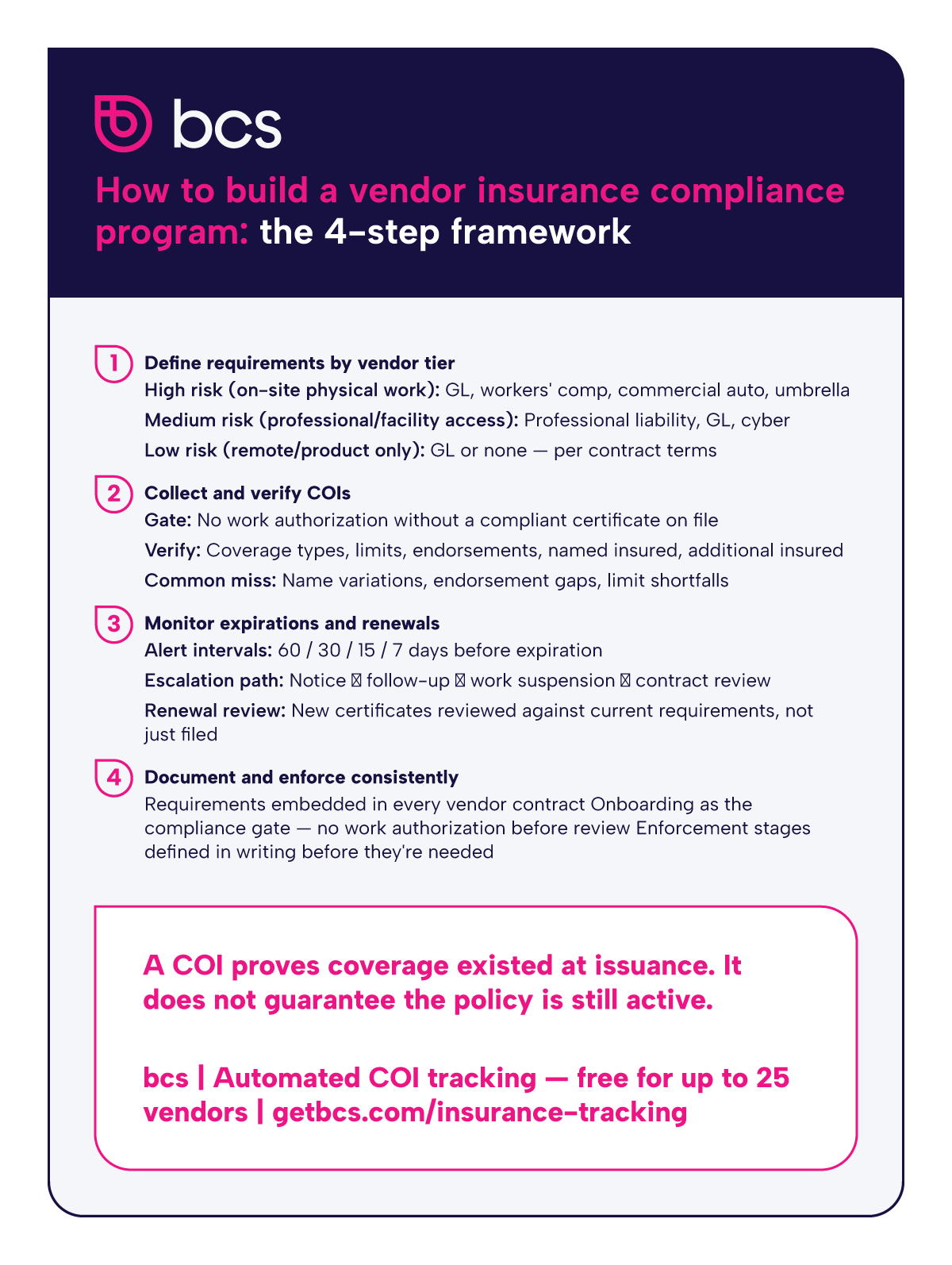
Consequences for non-compliance — and why they must be defined in advance
When a vendor fails to provide an updated certificate, what happens? The answer needs to be documented before the situation arises, not decided case by case, where the path of least resistance is accommodation rather than enforcement.
A tiered consequence structure:
- First stage: Formal notice with a defined cure period — typically 5–10 business days
- Second stage: Work suspension — the vendor is not authorized to perform work until compliance is restored
- Third stage: Contract review — persistent non-compliance may constitute a material breach depending on contract terms
Clear consequences convert compliance from a preference to a condition of the vendor relationship.
Manual vs. automated COI tracking — what changes at scale
Below a certain vendor volume, manual COI tracking works. At some point, it stops working reliably. The question isn't whether it will, but when.
Most organizations reach that threshold somewhere between 25 and 50 active vendors. Beyond it, COI tracking software handles the collection, verification, and monitoring functions that consume the most staff time under manual programs.
The transition from manual to automated tracking doesn't replace the compliance program. It removes the human memory dependencies — the manual alerts, the follow-up chains, the calendar checks — that create gaps in an otherwise sound framework.
Ready to automate what you just built?
Building a vendor insurance compliance program gives you the framework — defined requirements, a collection process, expiration monitoring, and documented enforcement. Executing that framework across dozens or hundreds of vendors is where the operational weight accumulates.
bcs automates COI collection, verification, and monitoring so the program you've defined runs without the manual overhead. Start free with full platform access for up to 25 vendors — no credit card, no time limit.
Frequently asked questions